
 2026.09.28
 Industry News
Empty a board game kit onto a table and the problems show up inside the first minute: a 50-in-1 set that arrives with 48 complete sets of pieces, one die where the rule sheet promises five, or a folding board that refuses to lie flat after a week in a humid warehouse.
The conclusion comes first: a board game kit is a bill of materials, not a game. Rules are the cheapest part to write. The cost, the risk and the repeat orders sit in the components, the packaging and the inspection routine. Buyers who quote a kit from its game list alone usually discover that at the port, with a container already loaded.
This guide walks through what an export kit actually contains, how kit formats change both price and risk, which tolerances belong in a specification sheet, and how custom kits are sourced from a game gift manufacturer such as Ningbo Royal.
Content
A board game kit is the complete sellable package, not only the games inside it. Every element is a separate line item with its own tooling, its own supplier and its own failure mode. Before artwork is approved, the bill of materials should be locked line by line and confirmed in writing.
| Component | Common specification | What fails in inspection |
|---|---|---|
| Folding board | 2-4 mm greyboard, matte lamination, fabric hinge | Warping after humidity, lifting hinge tape |
| Playing pieces | 12-25 mm wood, ABS or metal tokens | Colour drift between batches, burrs and sharp edges |
| Dice | 12-16 mm acrylic with rounded corners | Unfilled pips, size drift, wrong quantity per set |
| Rule sheet | 4-8 pages, 80-105 gsm, stapled or folded | Missing language version, wrong diagrams |
| Insert or tray | Vacuum-formed PET or EVA foam | Pieces rattle, chip or migrate in transit |
| Closure | Neodymium or ferrite magnet, or metal latch | Magnet too weak to hold the lid when inverted |
| Outer box | 300-400 gsm greyboard with litho wrap | Corner crush, drop-test failure |
Two questions separate a prepared buyer from a hopeful one. Which of these lines are produced in-house, and which are outsourced? And what happens to the shipping date when one outsourced component arrives a week late? The same checklist scales up to an entire board game collection, which is why assortment planning and component planning belong in the same meeting rather than in two different departments.
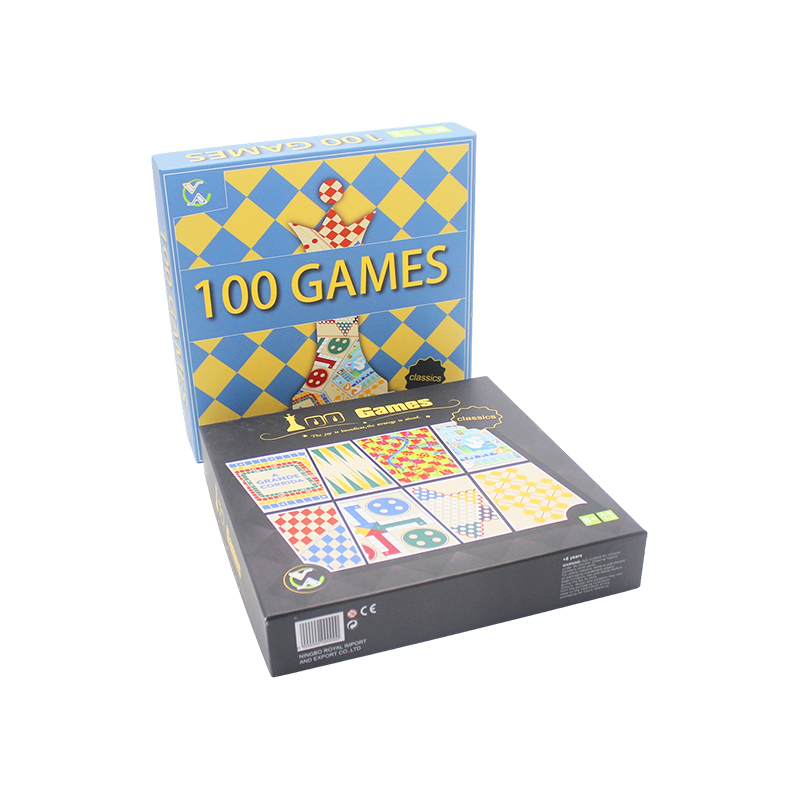
Multi-game kits are sold by the number of games inside, and that number is the most useful single proxy for unit cost, packing time and complaint rate.
A 5-in-1 tin is a travel and impulse product: small footprint, low piece count, easy to display at a till point. A 50-in-1 or 100-in-1 gift box is a different animal. Piece counts multiply, the insert becomes a moulded part rather than a folded sheet, packing labour rises sharply, and every single missing pawn becomes a customer complaint that costs far more than the pawn.
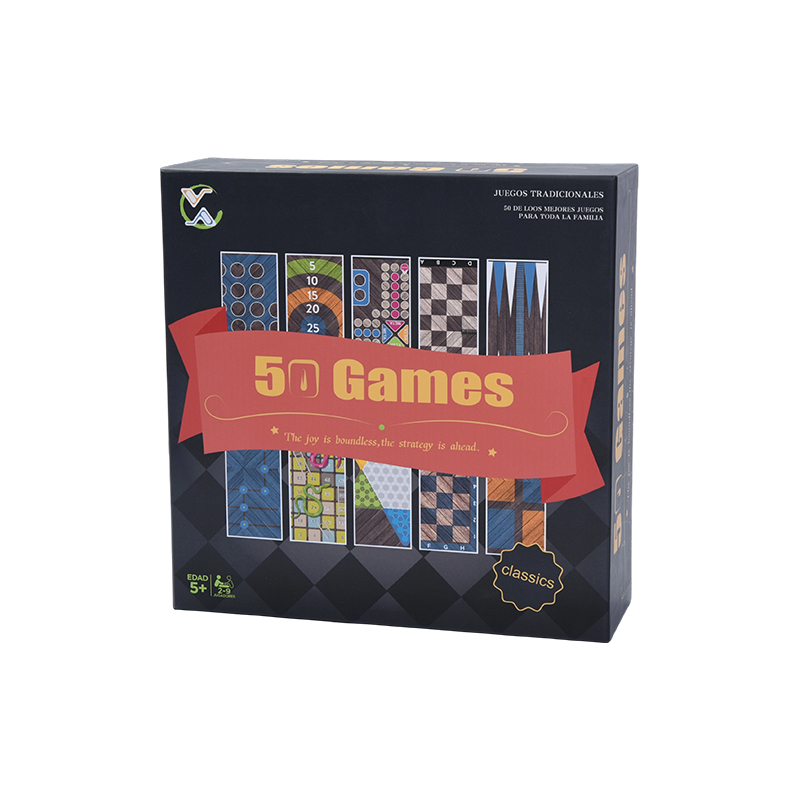 50-in-1 Traditional Board Game SetMaterial Design Storage Box: Recycled paperboard with matte black finish and UV-printed game motifs. Components: Plastic game pieces in black/white/beige/multicolor. R...View Product →
The practical rule: pick the format that matches the sales channel, not the format with the longest game list. Multi-game kits are the fastest way to build a board game collection for a gift or travel programme, but they should not be quoted from the game count alone. Ask for a piece-count sheet that lists every set, every pawn and every die in the box.
Material choice is usually driven by three things: the retail price band, the destination climate and the transport mode. A rigid gift box looks premium on a shelf but takes more container volume than a flat tin. Wooden pieces feel better in the hand but vary more in colour and dimension than injection-moulded ones. Metal tins protect the contents well but dent, so they need corner protection in the master carton.
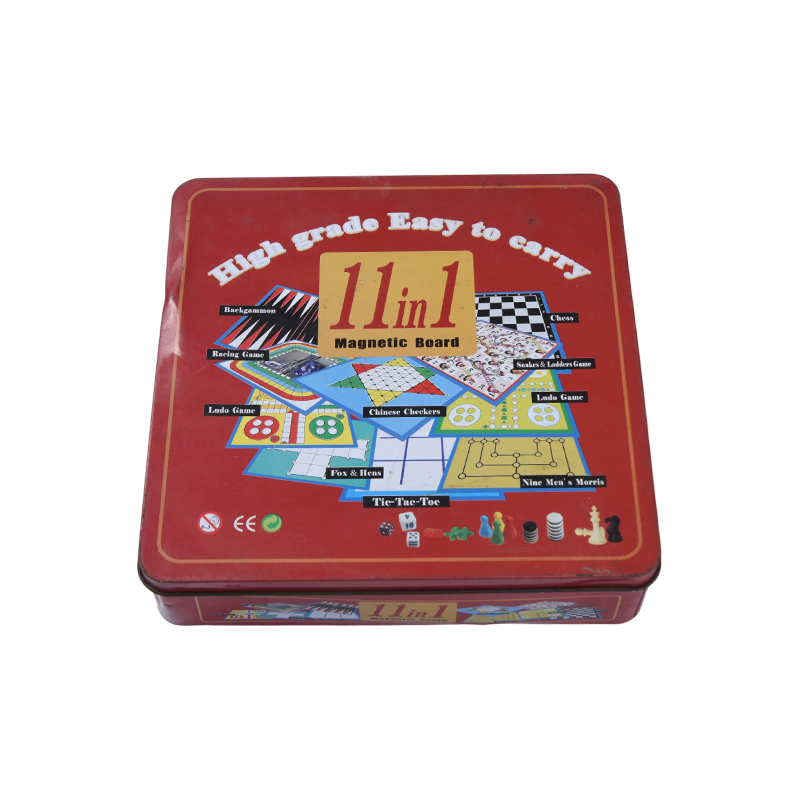 11-in-1 Magnetic Board Game Set in Red Metal TinProduct Features 1. Eleven Classic Games in One Portable SetView Product →
Tolerances belong in the specification, not in a verbal promise. Write in board dimensions with an allowance, piece diameter with an allowance, and a closure requirement such as a lid that stays shut when the closed kit is turned upside down and shaken gently. If the supplier cannot state a tolerance, the sample you approve is not a standard, it is a lucky draw.
Unit price is not set by the number of games. It is set by the following, roughly in order of impact:
Most kit disputes are not quality disputes, they are counting and documentation disputes. This sequence catches nearly all of them:
Keep the inspection record with the shipping documents. When a buyer in another market raises a claim, a signed checklist usually ends the conversation faster than any email chain.
Once the components are stable, customisation becomes the easy part. Logo printing on the lid, a themed board, a bespoke rule sheet in the buyer's language and branded packaging are all routine requests, and a themed board can be built on the same tooling as a standard one. The same approach works for custom card games, where a standard card stock and finish can carry a completely different theme and audience.
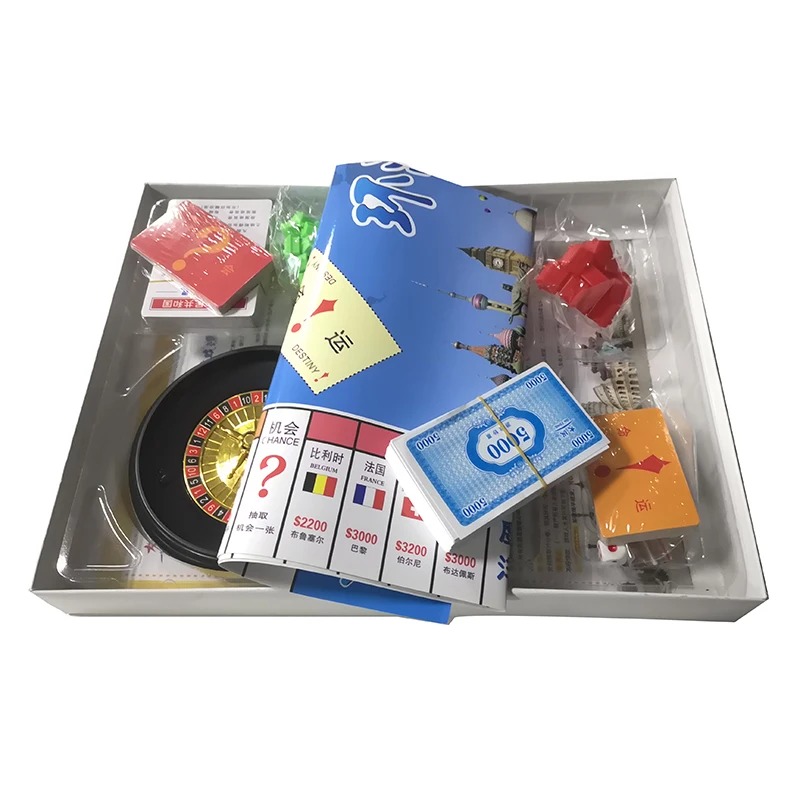 Custom Board Game Collection - Multi-Theme Family Gaming SetPremium Components: Food-grade, BPA-free plastic for safe handling Color Spectrum: 12 distinct themes with vibrant hues - including emerald jungles, sapphire oceans, a...View Product →
Send artwork and a clear brief: target retail price, destination market, language list and the age grading you intend to print. Suppliers who receive all four in the first email quote accurately; suppliers who receive only a mood board end up guessing, and the guess appears in the sample.
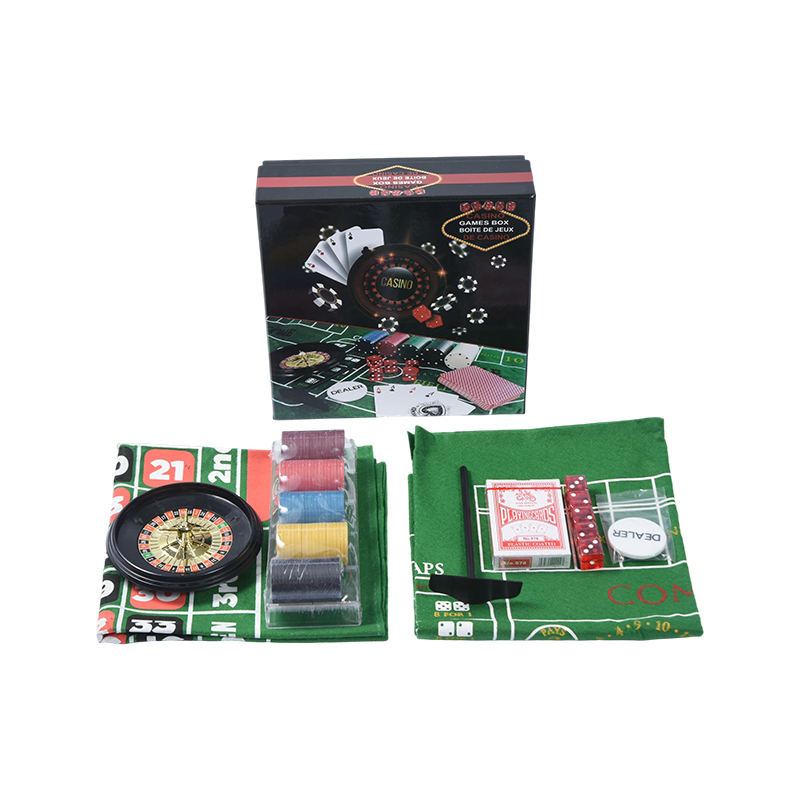
Ningbo Royal Import And Export Co., Ltd. is a professional game product sets manufacturer and game gift products factory, equipped with complete testing facilities and strong technical force. The product range covers educational games, board games, classic games, casino style sets, drinking games, tabletop games, outdoor sports games and accessories, with multi-game formats from 5-in-1 travel tins up to 100-in-1 gift box collections.
Products are diverse in variety, superior in quality, reasonable in price and fashionable in design, and are widely used in industries such as gaming. The company states that it can supply test reports against GB, EN and REACH-type requirements, and that its eco-first approach prioritises biodegradable and recyclable materials from raw material selection through production. Products have been widely recognised and trusted by users and can meet the constantly changing economic and social demands. New and old customers from all walks of life are welcome to make contact for future business relations and common success.

A professional enterprise specializing in the production of game gift products, with complete testing equipment and strong technical force.
Read MoreCONTACT US
For exclusive deals and latest offers, sign up by entering your email address below.
ORGANAIZATION INFO
Address: No. 329, Fangyan Road, Luotuo Street, Zhenhai District, Ningbo City, Zhejiang Province, China.
Phone:+86 15990507778
E-mail:[email protected]
Copyright © Ningbo Royal Import And Export Co., Ltd. All Rights Reserved. China Game Product Sets Manufacturers Wholesale Game Gift Products Factory privacy



 English
 Español
 Deutsch