
 English
 Español
 Deutsch


Content
- 1 The Short Answer: What Is American Mahjong
- 2 A Short History of Mahjong in the United States
- 3 Mahjong Tiles Explained: The 152-Tile American Set
- 4 Tile Size, Thickness, Weight and Material
- 5 Setting Up the Table: How Many Tiles to Start With
- 6 How to Play Mahjong American Style, Turn by Turn
- 7 The Charleston: Passing Tiles Before the First Discard
- 8 Reading the National Mah Jongg League Card
- 9 Mahjong Strategies for New Players
- 10 American Mahjong Compared With Other Styles
- 11 Is Mahjong Hard to Learn: A Simple Plan for Beginners
- 12 Choosing Mahjong Tiles for Home Play
- 13 Mahjong Tiles FAQ
- 13.1 Q1. How many tiles are in a mahjong set?
- 13.2 Q2. How many mahjong tiles do you need?
- 13.3 Q3. What size are mahjong tiles?
- 13.4 Q4. How much does a mahjong tile weigh?
- 13.5 Q5. What are mahjong tiles made of?
- 13.6 Q6. Are mahjong tiles plastic?
- 13.7 Q7. Are acrylic mahjong tiles durable?
- 13.8 Q8. How thick are mahjong tiles?
- 13.9 Q9. What is the standard mahjong tile size?
- 13.10 Q10. How big is a mahjong tile?
- 13.11 Q11. How many tiles do you start with in mahjong?
- 13.12 Q12. Is mahjong hard to learn?
The Short Answer: What Is American Mahjong
American mahjong is a four-player tile game played with 152 mahjong tiles, eight jokers and a yearly card of approved winning hands. Each player starts with 13 tiles (the dealer takes 14), trades unwanted tiles in a passing step called the Charleston, then draws and discards until one player completes a hand printed on the card and calls "Mah Jongg."
If you typed what is mahjong game into a search bar, that is the answer in one line. The game mahjong is a rummy-style game in which players collect matching sets and pairs of tiles. What separates American mahjong from the versions played in Asia is the use of jokers, flowers that count as playable tiles, and a card issued each year by the National Mah Jongg League that lists the only hands that count as wins.
This guide is written as mahjong for beginners. It covers the tiles, the setup, the turn flow, the Charleston, the card, beginner strategy and the questions new players ask most often. It also follows the rules of mahjong american clubs use, based on the standard rules published by the National Mah Jongg League.
| Topic | Detail |
|---|---|
| Players | Four |
| Tiles in the set | 152 |
| Starting hand | 13 tiles, or 14 for the dealer |
| Special tiles | 8 jokers and 8 flowers |
| Passing step | The Charleston |
| How you win | Complete a hand shown on the current card |
| Governing body | National Mah Jongg League, founded in 1937 |
Pronunciation and Spellings
Most American players say mah-JONG, with the first syllable rhyming with "spa" and the second with "song." That is the usual answer to mahjong pronunciation american searches. Some players soften the ending toward "zhong," and both versions are understood at any table.
The league spells the name mah jongg with two Gs, while retailers and rule sites often write mahjong, mah-jong or mah jong. Searchers also type misspellings such as majong, mahong, majon and majhon. All of these point to the same game.
A Short History of Mahjong in the United States
To understand the fabulous game of Mahjong, let's take a trip down memory lane and explore the fascinating history.
Mahjong, the Chinese tile-based game, has been around for over a century, but its exact origins are still a bit of a mystery. Some say it was invented during the Qing Dynasty in China, while others claim it originated in the court of the Ming Dynasty. What is clear is that it has been popular in China and beyond for many years.
As for how mahjong made its way to the United States, the credit goes to a man named Joseph P. Babcock. Back in the 1920s, Babcock was working as an American representative for the Standard Oil Company in China when he came across the game.
At first, the game was a tough sell to Americans.
By the roaring 20s, mahjong was all the rage in the US and people could not get enough of it. The problem was that the game was played with different rules depending on where you were, and there was no standardization.
So, in 1937, a group of mahjong enthusiasts got together in New York City and formed the National Mah Jongg League (yes, it is spelled with two Gs, and that spelling has stuck). Their mission was simple: to create a standardized set of rules that everyone could agree on and to promote the game across the country.
According to the league's own website, 2026 marks its 89th year, and it still publishes a new card of official hands every spring. That yearly card is the reason American mahjong keeps changing from one season to the next, while the tiles themselves stay the same.
Mahjong Tiles Explained: The 152-Tile American Set
An American set uses 152 mahjong tiles: 108 suit tiles, 28 honor tiles (winds and dragons), 8 flowers and 8 jokers. The counts below follow the standard set described by the National Mah Jongg League.
| Tile group | Quantity | What is on the tile |
|---|---|---|
| Craks (characters) | 36 | Numbers 1 to 9, four of each |
| Bams (bamboo) | 36 | Numbers 1 to 9, four of each |
| Dots (circles) | 36 | Numbers 1 to 9, four of each |
| Winds | 16 | East, South, West and North, four each |
| Dragons | 12 | Red, Green and White, four each |
| Flowers | 8 | Flower designs, treated as matching tiles |
| Jokers | 8 | Wild tiles with limited use |
| Total | 152 | A full American set |
Suit Tiles
The three suits are Craks, Bams and Dots. Each suit has the numbers 1 to 9 with four copies of every number, which gives 36 tiles per suit. On many sets the 1 Bam carries a bird instead of a single bamboo stalk, which is worth knowing before your first game.
Winds and Dragons
Winds and dragons are the honor tiles. There are four copies of each wind and four copies of each dragon. The White dragon is often called Soap by American players, because the tile is blank or framed with a plain border. Honor tiles appear in many card sections, so they are worth watching during the Charleston.
Flowers
Flowers work differently from other mahjong styles. In American mahjong they stay in your hand as normal tiles, and any flower can stand in for any other flower when a hand calls for them. They are not swapped out for a replacement draw.
Jokers
Each set has eight jokers. A joker can replace any tile in a group of three or more identical tiles, but it cannot be used in a pair or as a single tile. Jokers cannot be passed during the Charleston, and a discarded joker cannot be claimed.
Some retail sets ship with more than 152 mahjong tiles. Extra pieces such as spare jokers or blank tiles explain the higher counts you may see on product listings, so read the contents list before you rely on a number.
Tile Size, Thickness, Weight and Material
There is no single official size for a mahjong tile. American-style tiles are often larger than tiles in many Asian-style sets, and many measure around 1.5 inches tall, 1.1 inches wide and 0.7 to 0.8 inch thick. Exact numbers vary by manufacturer, so check the specification of any set you plan to use.
What Mahjong Tiles Are Made Of
Older sets were carved from bone and bamboo, and mid-century sets often used Bakelite or catalin. Most modern sets are molded from resin-based plastics, with melamine and acrylic the two common choices. That answers a frequent question: yes, current mahjong tiles are plastic, although vintage collector sets are not.
| Material | Typical look and feel | Where it appears |
|---|---|---|
| Melamine | Dense, hard and matte to satin | Everyday home sets |
| Acrylic | Glossy, often layered with clear edges | Decorative and gift sets |
| Bakelite or catalin | Warm color, heavy in the hand | Vintage collections |
| Bone and bamboo | Two-tone, light and natural | Antique sets |
Weight and Durability
A single tile often weighs somewhere around 15 to 25 grams, depending on its size and material, and a full 152-tile set commonly weighs a few pounds. Acrylic tiles hold up well through regular play. They can pick up fine scratches if they are slid across rough surfaces, so a soft mat under the table helps, and a damp cloth is enough for cleaning.
What to Check on a Tile
- Engraving depth: marks should be clear enough to read from across the table.
- Color fill: the color inside the engraving should sit level and stay in place after handling.
- Edge finish: smooth edges and corners are more comfortable to hold and push.
- Uniform thickness: tiles of equal height stack into a level wall.
- Rack fit: the tiles should sit securely in the racks that come with the set.
To compare options, you can browse the Mahjong Tiles category from Ningbo Royal Import And Export Co., Ltd.
Setting Up the Table: How Many Tiles to Start With
In mahjong how many tiles to start is a simple count: each player begins with 13 tiles, and the dealer, called East, begins with 14. That uses 53 of the 152 tiles and leaves 99 in the wall.
- Seat four players around the table. Play moves counterclockwise, and the dealer takes the East seat.
- Turn all tiles face down and mix them, then have each player build a wall that is 19 tiles long and two tiles high. Four walls of 38 tiles use all 152 tiles.
- The dealer rolls the dice. The total decides where the wall is opened and where dealing starts.
- Tiles are dealt in groups of four until each player has 12. Then each player takes one more tile and the dealer takes two.
- Stand your tiles on your rack, face toward you. Keep flowers and jokers in your hand, because they are playable tiles in this game.
- Place your card where you can read it. Every hand you build must match a line on it.
| Item | Number of tiles |
|---|---|
| Full set | 152 |
| One wall | 38 (19 stacks of two) |
| Dealer hand | 14 |
| Each other player | 13 |
| Left in the wall after the deal | 99 |
How to Play Mahjong American Style, Turn by Turn
After the Charleston, the dealer discards first, and every turn after that is a draw followed by a discard. That loop is the heart of mahjong how to play, and it repeats until someone calls Mah Jongg or the wall runs out. These instructions for playing mah jongg apply to a standard four-player table.
Drawing and Discarding
On your turn, take one tile from the wall, compare it with the hands you are building, and discard one tile face up in the center. Say the name of the tile aloud as you place it, for example "three Dot" or "North." Your hand stays at 13 tiles between turns and returns to 14 after each draw.
Calling a Discard
Any player may claim a discard, but only for a limited set of reasons. You can take it to complete a pung (three identical tiles), a kong (four), a quint (five) or a sextet (six), or to finish your hand with Mah Jongg. You cannot claim a discard just to build a run of consecutive numbers unless that tile completes your winning hand. Call the tile out before the next player draws, then expose the group on your rack so everyone can see it.
Using Jokers
Jokers can fill in for any tile in a group of three or more. If an exposed group contains a joker, any player may swap in the natural tile the joker stands for on their own turn and take the joker. Joker swaps are one of the most useful skills for a new player to practice.
Winning the Game
You win by completing a hand that matches a line on the current card and saying "Mah Jongg." You can win on your own draw or on a discard. If you declare with a hand that is not on the card, that hand is dead and you can no longer win that round. If the wall runs out and nobody has won, the game is a draw and the tiles are reshuffled for a new deal.
The chart shows why a game feels shorter than the wall suggests. With four players drawing once per round, the wall runs low after roughly two dozen rounds, and claimed discards move the turn order and can bring the end even sooner. Plan your hand early rather than waiting for late draws.
Common Beginner Mistakes
- Claiming a discard for a run of numbers that is not part of a completed hand.
- Placing a joker in a pair or a single tile.
- Passing a joker during the Charleston.
- Exposing a group early and then finding no card hand that fits it.
- Forgetting that a hand marked concealed cannot include exposed groups.
The Charleston: Passing Tiles Before the First Discard
The Charleston is a passing sequence in which each player trades three unwanted tiles at a time before play begins. The first Charleston is required, the second is optional, and jokers can never be passed.
| Pass | Direction | Required | Notes |
|---|---|---|---|
| First Charleston, pass one | Right | Yes | Pass three tiles |
| First Charleston, pass two | Across | Yes | Pass three tiles |
| First Charleston, pass three | Left | Yes | A blind pass is allowed |
| Second Charleston, pass one | Left | Only if all four agree | Pass three tiles |
| Second Charleston, pass two | Across | Only if all four agree | Pass three tiles |
| Second Charleston, pass three | Right | Only if all four agree | A blind pass is allowed |
| Courtesy pass | Across | Optional | Zero to three tiles, agreed by both players |
What Is a Blind Pass
On the last pass of each Charleston, you may pass tiles you have just received without looking at them. That lets you send along tiles you do not want without giving your own hand away, and it is a handy option when you are short on discards from your own rack.
What to Pass and What to Keep
Pass tiles that fit none of the hands you are considering. Isolated tiles from a suit you are not using are the easiest to send away. Keep pairs, matching numbers across suits, and honor tiles that appear in several card lines. Because jokers cannot be passed, you never have to decide whether to give one up.
Reading the National Mah Jongg League Card
The card is a yearly sheet listing every hand that counts as a win in American mahjong, and you need a hand that matches one of its lines to call Mah Jongg. This is what people mean when they search how to play mahjong cards or how to play mahjong with cards: the cards are the league's hand card, not a deck of playing cards.
The league typically releases a new card each spring. According to card retailers, the 2026 card was released on April 17, 2026, and it stays in use until the next edition arrives in spring 2027. Your tiles do not change when the card does. Only the list of hands changes.
| Section | What it covers |
|---|---|
| Year hands | Hands built around the digits of the current year |
| 2468 | Hands made of even numbers |
| Any Like Numbers | Matching numbers repeated across suits |
| Quints | Groups of five identical tiles, which need at least one joker |
| Consecutive Run | Numbers in sequence |
| 13579 | Hands made of odd numbers |
| Winds and Dragons | Hands that lean on honor tiles |
| 369 | Hands built on 3, 6 and 9 |
| Singles and Pairs | Hands of single tiles and pairs, with no jokers allowed |
Concealed, Exposed and Point Values
Each line on the card carries a marker. An X means the hand may include groups claimed from discards. A C means the hand must be concealed, so every tile comes from your own draws, apart from the final tile if you win on a discard. Each hand also has a point value, and card guides note that values are typically 25, 30, 35 or 50 points, with concealed and harder hands worth more.
The card uses colors to show suits. The colors stand for any suit, so a line printed in green can be built in Craks, Bams or Dots as long as the suit pattern matches. New players usually find it easier to read one line at a time, left to right, than to take in the whole sheet at once.
Instructions for Playing Mah Jongg in Short
- Set up the walls and deal 13 tiles to each player, with 14 for the dealer.
- Play the first Charleston, then the optional second Charleston and courtesy pass.
- The dealer discards first, and play moves counterclockwise.
- Draw a tile, then discard one, naming the tile aloud.
- Claim a discard only for a pung, kong, quint, sextet or to win.
- Use jokers in groups of three or more, never in pairs or singles.
- Call Mah Jongg when your 14 tiles match a hand on the current card.
Mahjong Strategies for New Players
The most reliable early strategy is to stay flexible. Do not commit to one card line until your tiles point to it, and keep two or three related hands open for as long as possible. These mahjong strategies work at any skill level.
- Choose flexible starting hands: sections with many similar lines let you switch when a needed tile does not appear.
- Use the Charleston to sort: pass tiles from suits you are not building and keep pairs and matching numbers.
- Count visible tiles: each number tile has four copies, so once three are visible, at most one remains for your hand.
- Save jokers for larger groups: a joker in a kong or quint is worth more than one used to finish a pung.
- Expose only when it helps: exposed groups show opponents what you are building and lock you into fewer hands.
- Watch discards: tiles that several players have thrown away are usually safer to discard than tiles nobody has released.
- Switch hands early: pivoting in the first few turns costs fewer tiles than pivoting late.
A Simple Turn Checklist
Before each discard, ask three questions: which hands am I still live for, which tile helps none of them, and is that tile safe to release. Answering them the same way every turn builds the habit faster than memorizing card lines.
American Mahjong Compared With Other Styles
American mahjong uses the largest set, 152 tiles, because it adds jokers to the flowers found in some other styles. The tile counts below follow the commonly published rules for each style.
| Feature | American | Japanese | Hong Kong | Taiwanese |
|---|---|---|---|---|
| Tiles in set | 152 | 136 | 136 or 144 | 144 |
| Jokers | 8 | None | None | None |
| Flowers | 8, played as tiles | None | Optional 8 | 8 bonus tiles |
| Starting hand | 13 (dealer 14) | 13 (dealer 14) | 13 (dealer 14) | 16 (dealer 17) |
| Hand reference | Yearly card | Fixed scoring patterns | Fixed scoring patterns | Fixed scoring patterns |
| Passing step | Charleston | None | None | None |
The radar shape explains a lot about the game. In the 152-tile set, flowers and jokers together make up about 10.5 percent of the tiles, which is why hands on the card can include them and why the Charleston matters so much. A 136-tile set has neither group, so the suits carry a larger share of the play.
Is Mahjong Hard to Learn: A Simple Plan for Beginners
Most new players can follow a full game after a few short sessions. When people ask is mahjong hard to learn, the honest answer is that the basic steps are easy and the depth comes from reading the card and planning hands. Easy mahjong rules are enough to start with, and the game rewards practice over time.
People who search majong rules or how do you play majong usually want the same thing, a short set of steps they can follow at the table. If you say i want to play mahjong, a four-week plan keeps the learning gentle and makes mahjong made easy in practice.
| Week | Focus | Goal |
|---|---|---|
| Week 1 | Tiles and names | Recognize all seven tile groups and their counts |
| Week 2 | Setup and turn flow | Build a wall, deal, draw, discard and call a pung |
| Week 3 | Charleston and jokers | Pass tiles in order and place jokers correctly |
| Week 4 | The card and a full game | Play a complete round with the card open |
Learn How to Play Mahjong Online
If you want to learn how to play mahjong online, video lessons and virtual tables are a practical way to see a full game before you sit down with real tiles. Check that any lesson or practice table uses the current year's National Mah Jongg League card, because older card hands no longer count in league play.
- Watch a full-length walkthrough of one game before you try to play.
- Pause during the Charleston and write down which tiles you would pass.
- Play a few online games with the card open, then switch to a physical set.
How to Teach Mahjong to a New Player
If you are teaching friends or family, keep the first session short. Keep the first game mahjong easy by limiting the rules to what players need right now. Players learn faster when the rules arrive in the order they are used.
- Start with the tiles: show each group and let players sort a full set.
- Deal a hand and explain the goal in one sentence.
- Play a few rounds of draw and discard with no card at first.
- Introduce claiming discards and the exposed groups.
- Add jokers, then the Charleston, in a second session.
- Bring out the card once players are comfortable with the flow.
Choosing Mahjong Tiles for Home Play
For American play, choose a set with the full 152 tiles, clear engraving and racks that hold a 14-tile hand. The material and color are a matter of taste, since the game itself does not change.
Sets in the same category can differ in tile size, layering, color and included accessories. The examples below are American-style sets from the Mahjong Tiles category at Ningbo Royal Import And Export Co., Ltd. Open a product page to read the full contents list before you decide.
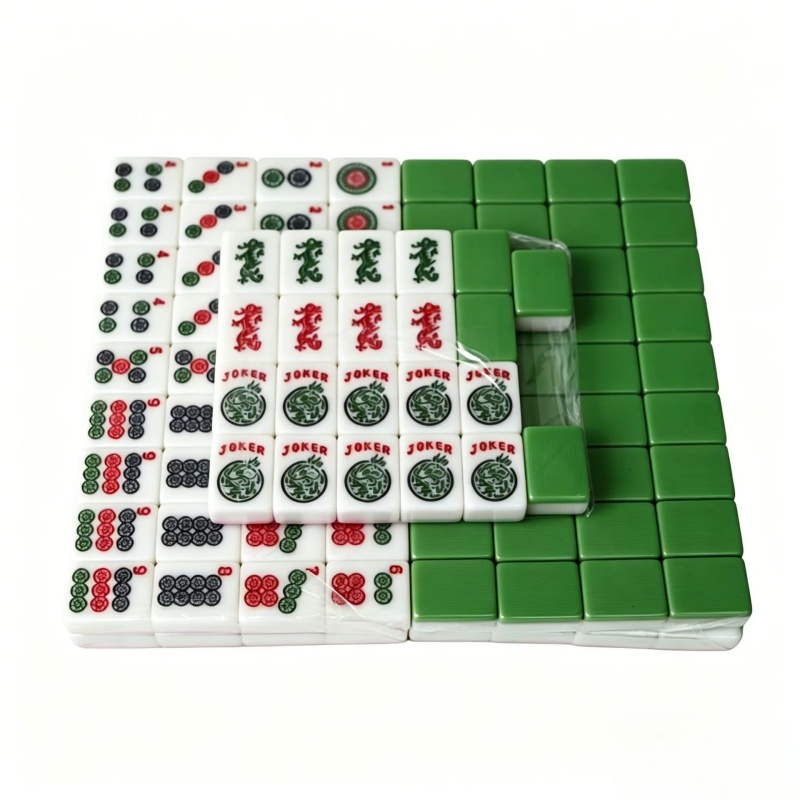
160-Piece American Mahjong Tile Set
Handcrafted acrylic mahjong tiles listed at 160 pieces. Check the listing for what the extra pieces beyond 152 include.
View product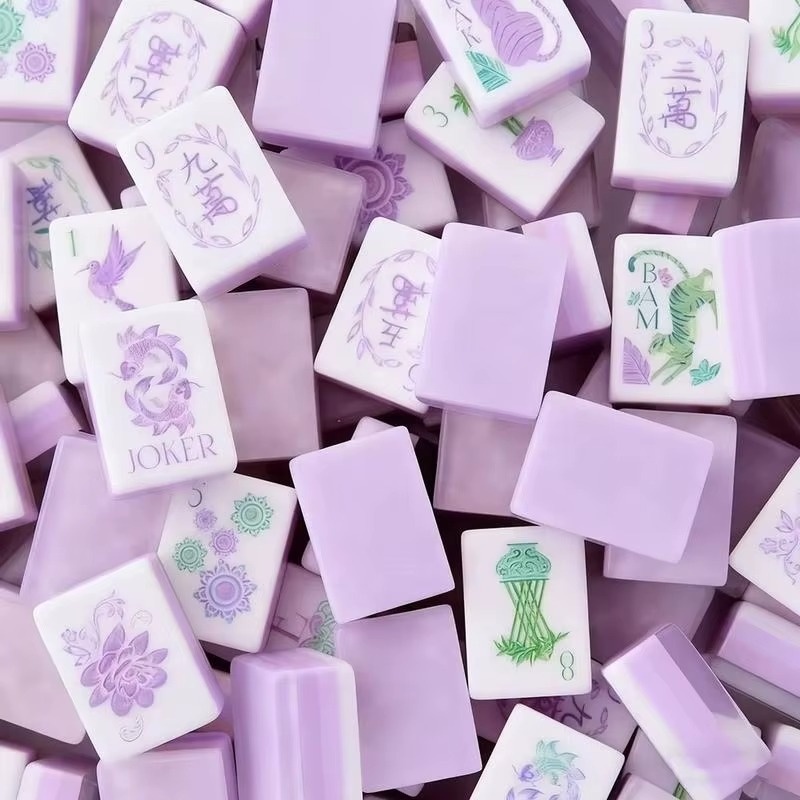
Ice Blue 4-Layer Acrylic Set
A four-layer acrylic American mahjong set in a cool ice blue color scheme.
View product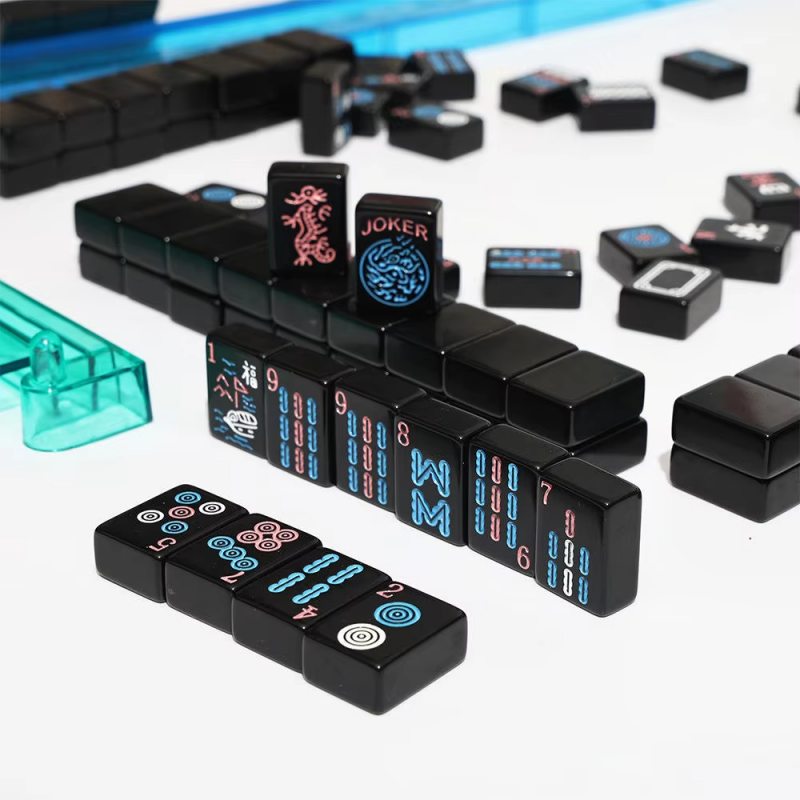
Modern Black Melamine Set
Melamine tiles in a modern black finish, made for American-style play.
View product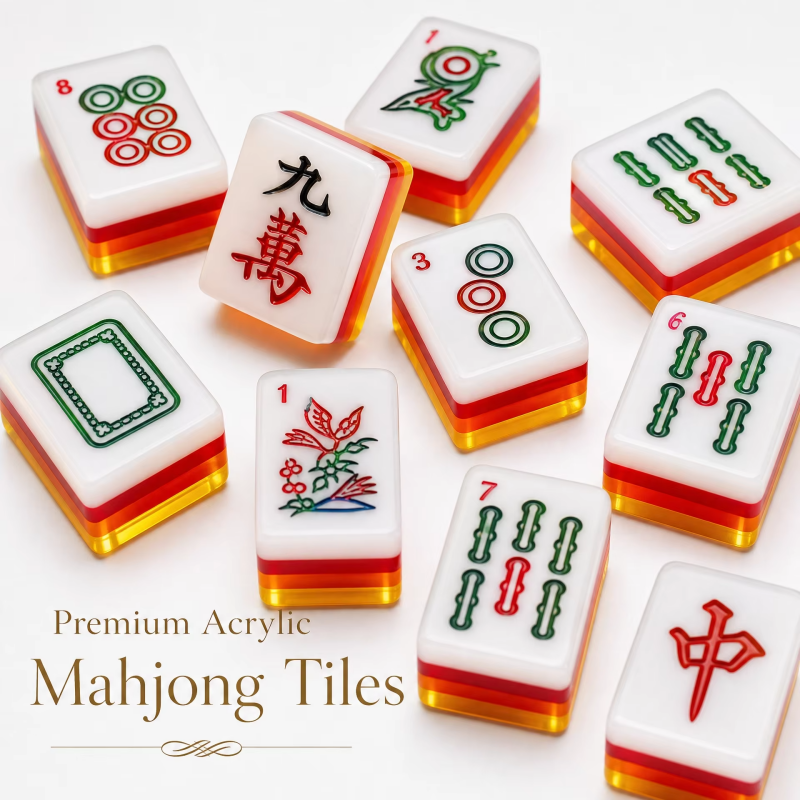
Multicolor 4-Layer Acrylic Set
A multicolor four-layer acrylic American set, listed with 160 tiles.
View productAbout the Manufacturer
Ningbo Royal Import And Export Co., Ltd. is a professional OEM Mahjong Tiles manufacturer and ODM Mahjong Tiles company, equipped with complete testing facilities and a strong technical team. Its products are diverse in variety, dependable in quality and fashionable in design, and are widely used in industries such as gaming. According to the company page, it has more than 10 years of experience customizing mahjong tiles. New and returning customers are welcome to get in touch about future business relations.
Mahjong Tiles FAQ
Q1. How many tiles are in a mahjong set?
An American set has 152 tiles. Other styles use 136 or 144, and some retail sets add spare jokers or blank tiles.
Q2. How many mahjong tiles do you need?
For American mahjong you need 152 tiles. Any extra pieces in a box are spares and are not dealt.
Q3. What size are mahjong tiles?
Sizes vary by set. American-style tiles are often about 1.5 inches tall, while travel sets use smaller tiles. Check the listed dimensions.
Q4. How much does a mahjong tile weigh?
Weight depends on size and material, and a single tile often falls around 15 to 25 grams. A full set commonly weighs a few pounds.
Q5. What are mahjong tiles made of?
Modern tiles are usually melamine or acrylic. Vintage sets used bone and bamboo, Bakelite or catalin.
Q6. Are mahjong tiles plastic?
Most current sets are made from resin-based plastics such as melamine and acrylic. Older collector sets may use other materials.
Q7. Are acrylic mahjong tiles durable?
Acrylic tiles hold up well through regular play. Use a soft mat to limit fine scratches and clean them with a damp cloth.
Q8. How thick are mahjong tiles?
American-style tiles are commonly around 0.7 to 0.8 inch thick, which is roughly 18 to 20 millimeters. Thickness differs between sets.
Q9. What is the standard mahjong tile size?
There is no single universal standard. Many American-style tiles measure about 1.5 by 1.1 by 0.75 inches.
Q10. How big is a mahjong tile?
A typical American tile is shorter than a standard domino but roughly twice as thick, so it sits comfortably in one hand.
Q11. How many tiles do you start with in mahjong?
Each player starts with 13 tiles and the dealer starts with 14. The wall holds 99 tiles after the deal.
Q12. Is mahjong hard to learn?
The basic turn flow is simple. Reading the card and planning hands takes more practice, and most beginners manage a full game in a few sessions.