
 2026.09.20
 Industry News
A gift importer orders 5,000 decks for a casino-themed box set. The second sample comes back with the artwork perfect and the cards wrong: too thin, slippery when shuffled, and the corners starting to split within a week of handling. Almost every buyer who has signed off on a playing cards printing order has met some version of that disappointment.
The design was never the problem. What failed was paper weight, core stock, coating, die-cut tolerance and quality control, four specs that look invisible on a drawing and painfully obvious in the hand. This article walks through them in the order that actually decides the outcome.
Content
If a deck feels cheap, no artwork will rescue it. In practice, the buying decision should follow this order:
Get the sequence wrong and every adjustment reopens plates, dies and quotations. Get it right and most of the arguments that normally erupt at the third sample simply never happen.
A playing card is a sandwich. Two printed facing sheets are glued to a central core that blocks light. That core decides three things customers notice immediately: whether the deck is see-through under a lamp, how it behaves after hundreds of shuffles, and how it springs back when bent.
Most suppliers offer three cores. Grey core is the cheapest and shows through under strong light, which is fatal for any game that depends on hidden information. Blue core sits in the middle: solid enough for retail decks and multi-game sets. Black core is fully opaque on both faces and is the usual choice when the back design is dense or when the deck is meant to look like casino equipment.
| Core type | Opacity | Shuffle durability | Typical use | Relative cost |
|---|---|---|---|---|
| Grey core | Low, shows through under strong light | Moderate | Promotional and giveaway decks | Lowest |
| Blue core | Medium | High | Retail decks, multi-game gift sets | Medium |
| Black core | High, opaque on both faces | High | Casino-style decks, dense back designs | Highest |
Ask for grammage, calliper and opacity in writing before approving a quotation. A 300 gsm sheet and a 350 gsm sheet can look identical in a photo and feel completely different in a hand.
Once the core is set, the coating decides whether a deck is pleasant or annoying to use.
A cheap and effective test: hand a sample to three people, let them shuffle for five minutes, then fan the deck. Coating defects show up in that window, long before a customer ever sees them.
Beyond standard decks, projects such as custom card games keep the back design, face layout, tuck box and rules card on one theme, which matters when the deck ships inside a larger gift set.
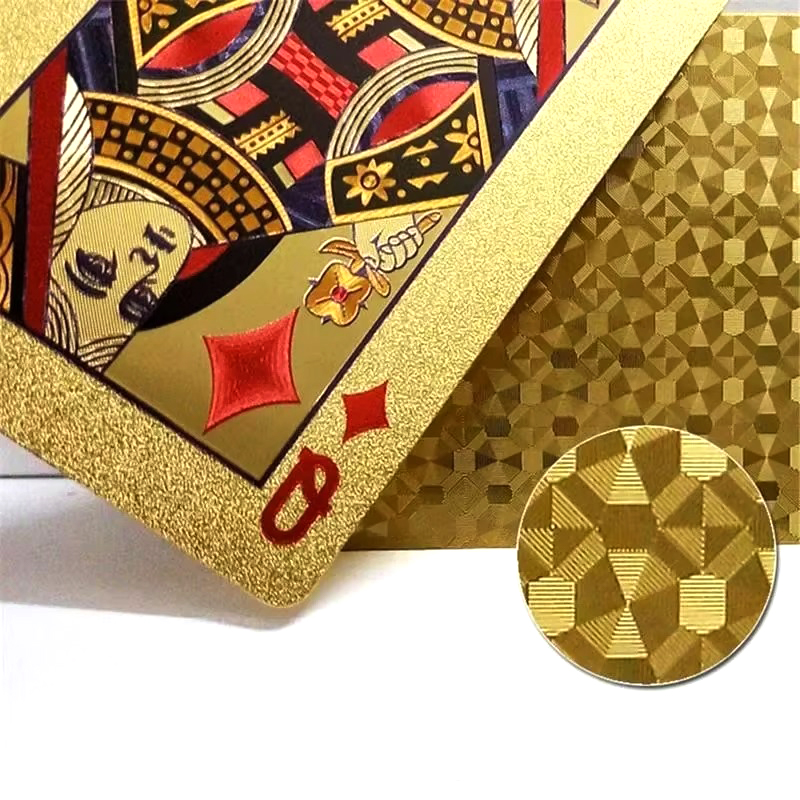 Gold-Plated Playing CardsPremium Materials: Made from high-quality, gold-plated material for a luxurious look and durable performance. Elegant Finish: Features a stunning gold foil texture tha...View Product →
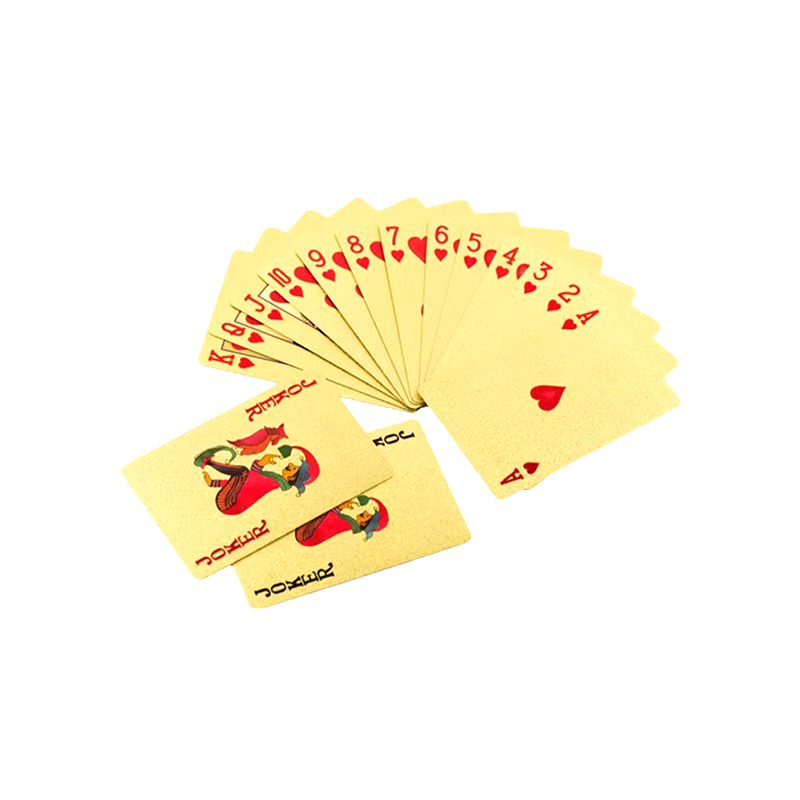
Where the look has to lean casino but the volume does not justify a fully bespoke run, an existing reference deck shortens the decision. Gold-plated playing cards give buyers a tangible benchmark for foil coverage and finish before committing to tooling.
Four formats cover almost every order, and one of them is usually a surprise to first-time buyers.
Bridge size is 57 x 89 mm and poker size is 63 x 88 mm, close enough that a box designed for one will not hold the other comfortably. Tarot decks run about 70 x 120 mm, and 44 x 67 mm mini cards are common in travel sets and promotional bundles.
Corner radius looks trivial until the die dulls. A torn, fuzzy corner catches on the card behind it, and within two weeks of play the deck will not fan cleanly. Put the radius, the permitted burr and the deck thickness tolerance into the specification. The standard count is 54 cards, being 52 plus two jokers; some markets add an extra rules or advertising card, which changes deck thickness and therefore the box.
Tins, acrylic cases, drawstring pouches and book-style boxes all have to be measured against the deck rather than guessed. Card thickness changes with paper weight, so a cavity cut for a 12 mm stack will not close over a 14 mm one. When the set includes dice, chips or a score pad, add every component to the drawing before tooling is confirmed. This is where most gift-box delays originate.
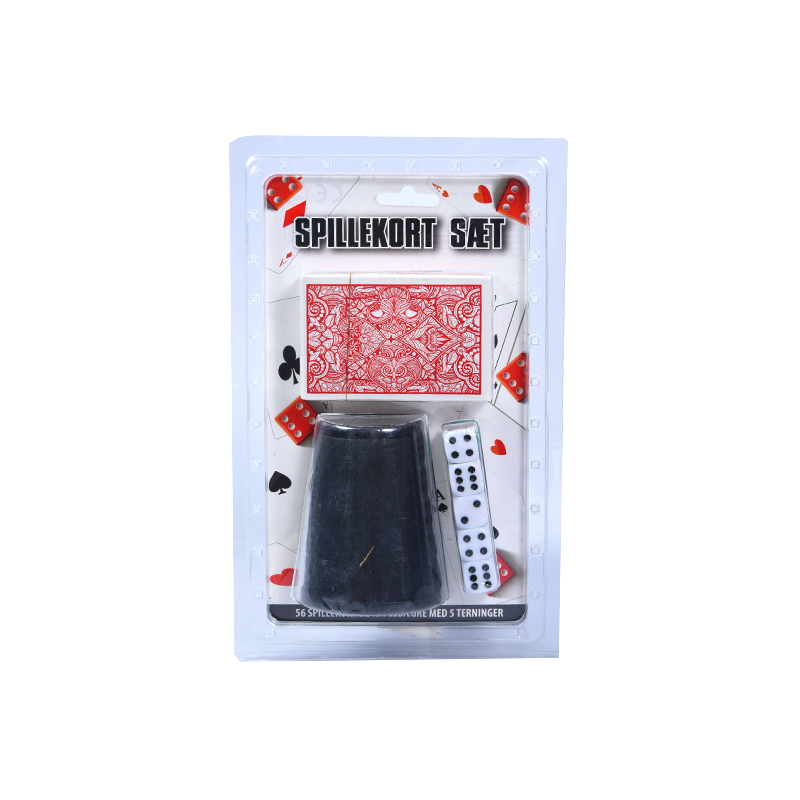
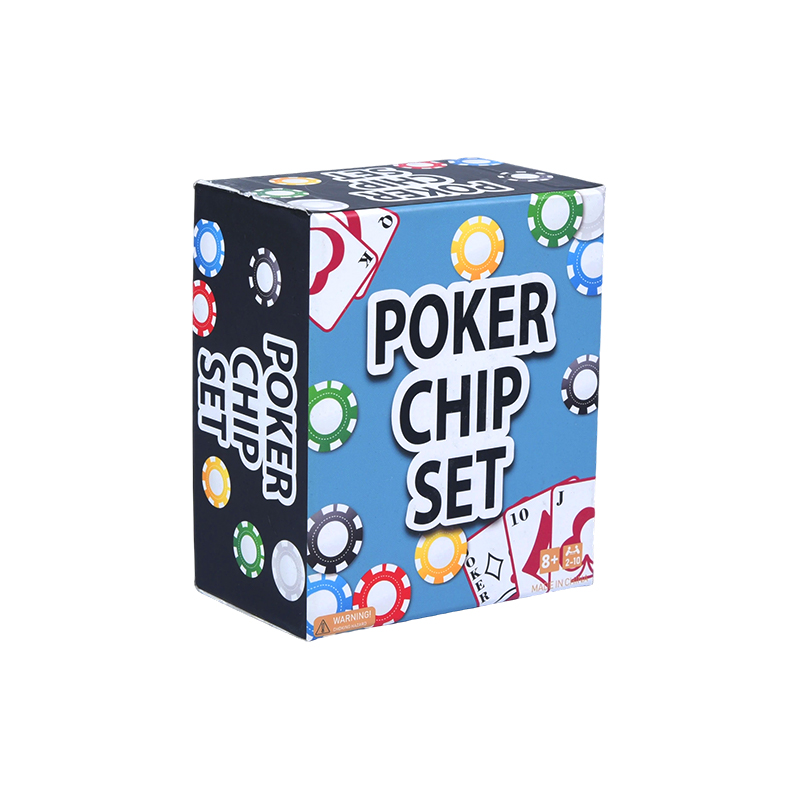
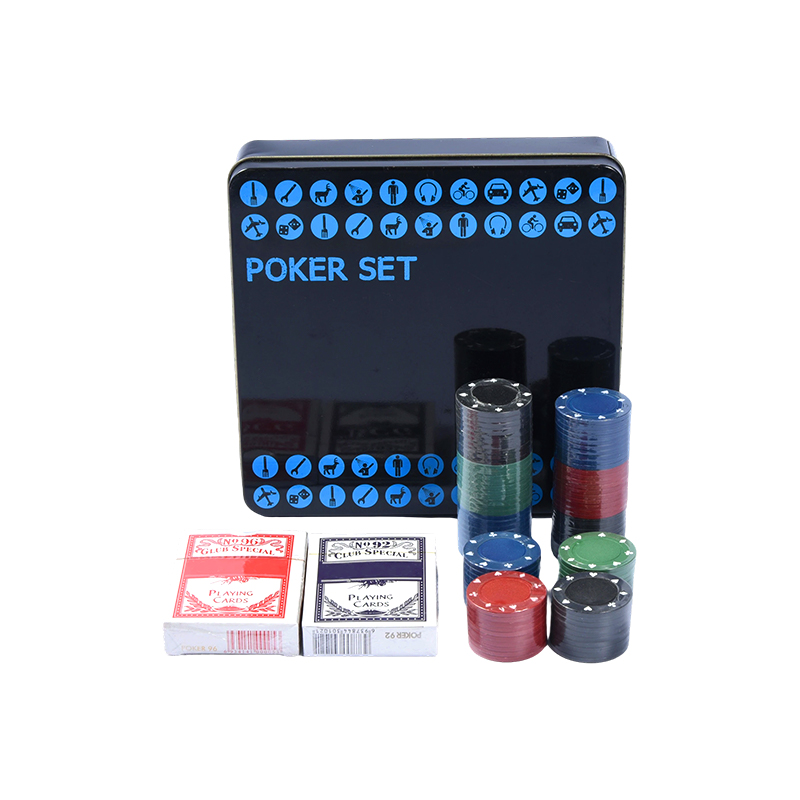
For casino-night sets, poker game sets typically bundle cards, chips and dice in one tin, and the cavity has to be dimensioned for the thickest combination in the range.
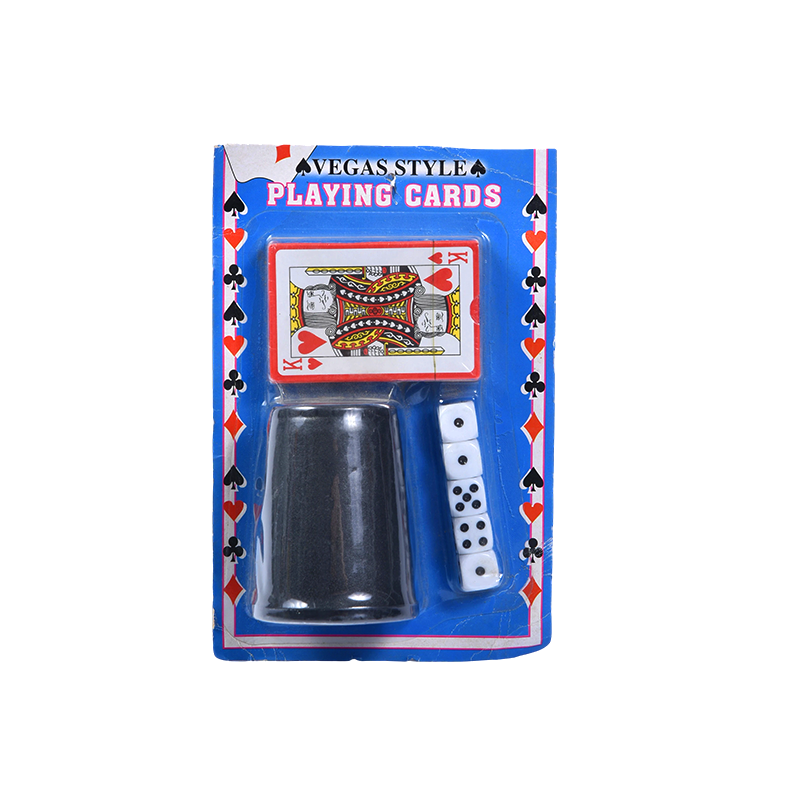 Vegas Style Playing Cards Set with Dice and Card HolderProduct Features Specifications 1. Complete Gaming SetView Product →
A ready-built reference such as a Vegas-style playing card set with dice and a card holder shows how a complete retail package is assembled, which helps while your own set list is still under negotiation.
Three proof routes are used in practice, and they are not interchangeable:
Once a proof is approved, write the numbers down: cut offset, colour tolerance, grammage variation, corner radius and deck thickness. Then state the test standards the order has to meet. GB, EN71 and REACH are the usual requirements, and the destination market decides which apply. For a toy or gift product sold to children, never leave that line blank.
On the factory floor, quality control should check four things every batch: corners, print defects, opacity of each card, and thickness consistency across the deck. A deck that varies in thickness will not stack evenly, and players notice within one game.
Ningbo Royal Import And Export Co., Ltd. is a professional game product sets manufacturer and game gift products factory, equipped with complete testing facilities and strong technical force. Its products are diverse in variety, superior in quality, reasonable in price and fashionable in design, and are widely used in industries such as gaming. The company's products have been widely recognised and trusted by users and can meet the constantly changing economic and social demands. New and old customers from all walks of life are welcome to make contact for future business relations and common success.
For playing cards printing projects, the practical advantage of that range is combination: a deck can be specified alongside classic games, board games, gambling sets, accessories and tin-box travel collections from one source, with one QC process and one packaging schedule. The catalogue spans classic games, board games, educational games, gambling games, drinking games, tabletop games, outdoor sports games and accessories, and custom options are available for boards, tokens, ceramic chips and packaging. The company also states an eco-first approach, prioritising biodegradable and recyclable materials from raw material selection through production. Buyers who need cards, chips and a gift box on a single purchase order can request samples and a combined quotation.
It depends on stock, coating and packaging. A standard tuck box usually starts lower than a tin or a wooden insert, and foil work or edge colouring raises the entry point. Send card count, size and packaging together for an accurate figure.
Proofing normally takes a few days, and bulk production runs several weeks after the sample is approved, with shipping time on top. If you have a fixed shelf date, state it in the enquiry.
Yes. Faces, backs and the tuck box can all carry custom artwork, and the same order can include hot foil, spot UV or coloured edges for a stronger shelf presence.
Yes, provided the size, card count and corner radius are fixed in the specification. Tarot formats, bridge decks, mini decks and fully custom counts are all workable.
GB, EN71 and REACH are the common requirements. Tell us the destination market when you enquire so the correct test reports can be matched to the order.
Yes, but the full set has to be measured before tooling. The insert cavity is cut to the actual deck plus accessory thickness, not to a nominal size from an old drawing.

A professional enterprise specializing in the production of game gift products, with complete testing equipment and strong technical force.
Read MoreCONTACT US
For exclusive deals and latest offers, sign up by entering your email address below.
ORGANAIZATION INFO
Address: No. 329, Fangyan Road, Luotuo Street, Zhenhai District, Ningbo City, Zhejiang Province, China.
Phone:+86 15990507778
E-mail:[email protected]
Copyright © Ningbo Royal Import And Export Co., Ltd. All Rights Reserved. China Game Product Sets Manufacturers Wholesale Game Gift Products Factory privacy



 English
 Español
 Deutsch