
 2026.10.21
 Industry News
Tip a mahjong set out of its case and line up the Dots: one set shows deep blue circles, another shows green ones, and a third mixes both on the same tile. All three are sold as traditional, and none of them breaks a rule, because mahjong has never had an international color standard. What it has is a set of regional habits that players repeat often enough to mistake for law.
The short answer, up front: in Chinese-style sets the three suits are normally color-coded, with Dots (Tong) in blue and green circles, Bamboo (Tiao or Suo) in green with red accents, and Characters (Wan) in red and dark blue. Red Dragon 中 is red, Green Dragon 發 is green, and White Dragon 白 is a blue or black frame around an otherwise blank tile. Everything past that point is a manufacturing decision, which is why two sets can both look correct and still not match each other.
Content
A tile identifies itself with its symbol, not its ink. A 3 of Dots is three circles, a 3 of Bamboo is three stalks, and a 3 of Characters carries the numeral 三 above 萬. Color is a secondary cue, which is why an oddly colored set still plays correctly and why a set with textbook colors can still be hard to read at arm's length.
The conventions most Chinese-made sets follow are consistent enough to be worth knowing:
Notice how few tiles depend on color alone. The Dragons are the only group where one color maps to one tile, and even there the character carries the meaning. Keep that in mind when we get to color vision.
| Group | Typical face colors | Tiles per set | Why the color is there |
|---|---|---|---|
| Dots (Tong) | Blue and green circles | 36 | Circle count identifies rank at a glance |
| Bamboo (Tiao) | Green stalks, red accents | 36 | Separates the suit from Dots at distance |
| Characters (Wan) | Red numeral, dark blue 萬 | 36 | Two-color split makes the numeral pop |
| Winds | Blue or black | 16 | Uniform color; the character does the work |
| Dragons | Red 中, green 發, blue or black 白 | 12 | Only group where one color equals one tile |
| Flowers and Seasons | Multicolor, no standard | 8 | Decorative; used for scoring only |
Two factories can both advertise traditional colors and ship tiles that look nothing alike. Four variables do most of the damage:
If you are sourcing rather than playing, our mahjong tiles set page shows the configurations we build. The one thing worth insisting on is symbol legibility: artwork that reads well on a large sample tile often fails once the same file is scaled down onto a smaller or cheaper body.
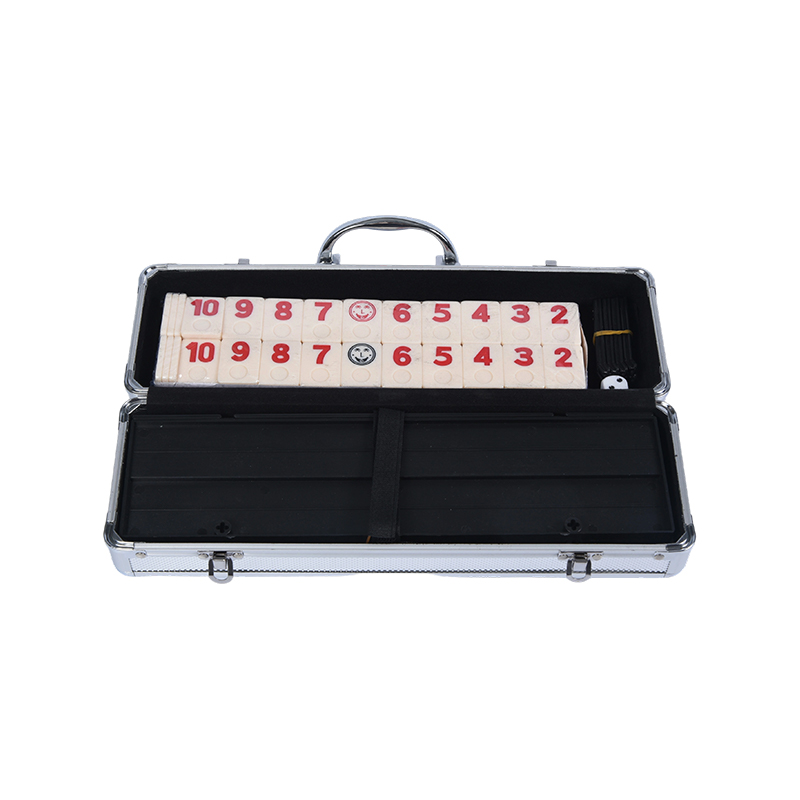 Metallic Numbered Tile Case with Expressive SymbolsDurable anodized aluminum case with numbered symbolic tiles and foam inserts, suited to portable tile games and organized storage.View Product →
American mahjong adds a printed card, and its colored ink confuses a lot of newcomers. Certified instructors are blunt about it: the colors on the card show how many suits a hand uses, not which suits. Red does not permanently mean Craks, green does not mean Bams, and blue does not mean Dots.
The practical consequence for buyers is simple. Do not choose a set to match a card, because the card is refreshed regularly and the ink is a code rather than a key. Choose tiles whose characters and counts stay legible under your room lighting, then keep a spare or two of each color from the same production batch, since a replacement pulled from a later run rarely matches.
In several variants, mahjong color stops being decorative and starts carrying a number:
Once color equals value, batch consistency stops being cosmetic. A green that drifts toward teal between production runs is not a design choice when players are counting points, and it is worse when they are counting money.
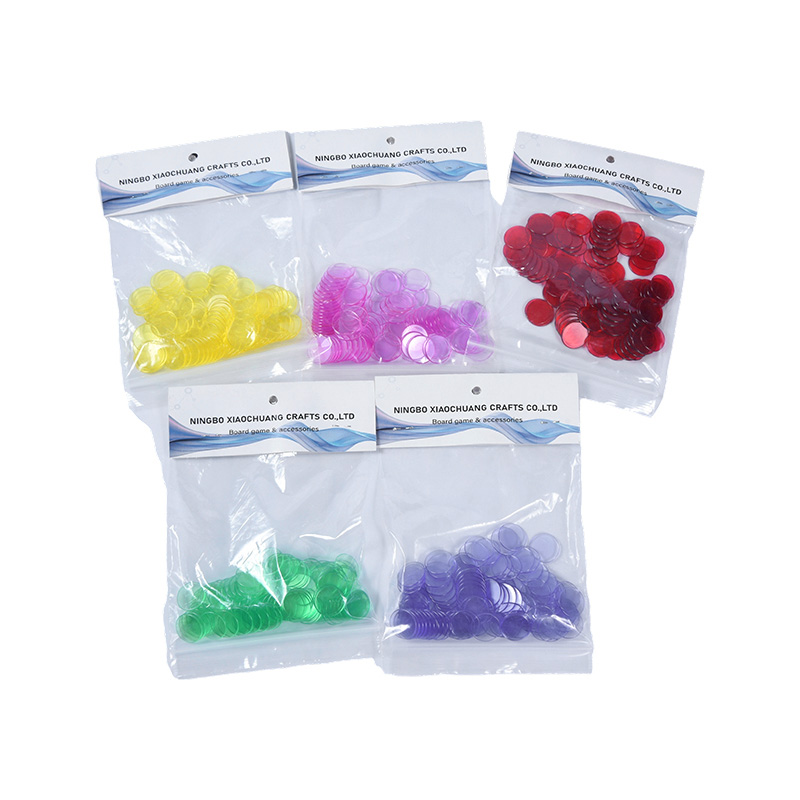 Assorted Color Translucent Bingo Chips SetFive-color BPA-free plastic tokens, stackable and scratch-resistant, packed in a clear screw-top jar for games and counting.View Product →
Red-green color vision deficiency affects roughly 1 in 12 men and about 1 in 200 women, according to the UK charity Colour Blind Awareness. Around a mahjong table that is exactly the range where traditional choices collide: the red 中 against the green 發, red accents sitting on green bamboo, and blue-green Dots that are close in tone.
Sets that hold up for these players tend to do three things. They dual-code every tile with a shape or a count, so color is a bonus rather than the only clue. They push contrast between adjacent inks instead of chasing a pretty palette. And they avoid high-gloss finishes, which throw highlights across the face and flatten the difference between two similar shades. Dot-based games solved this decades ago, which is part of why dotted dominoes still work for almost everyone.
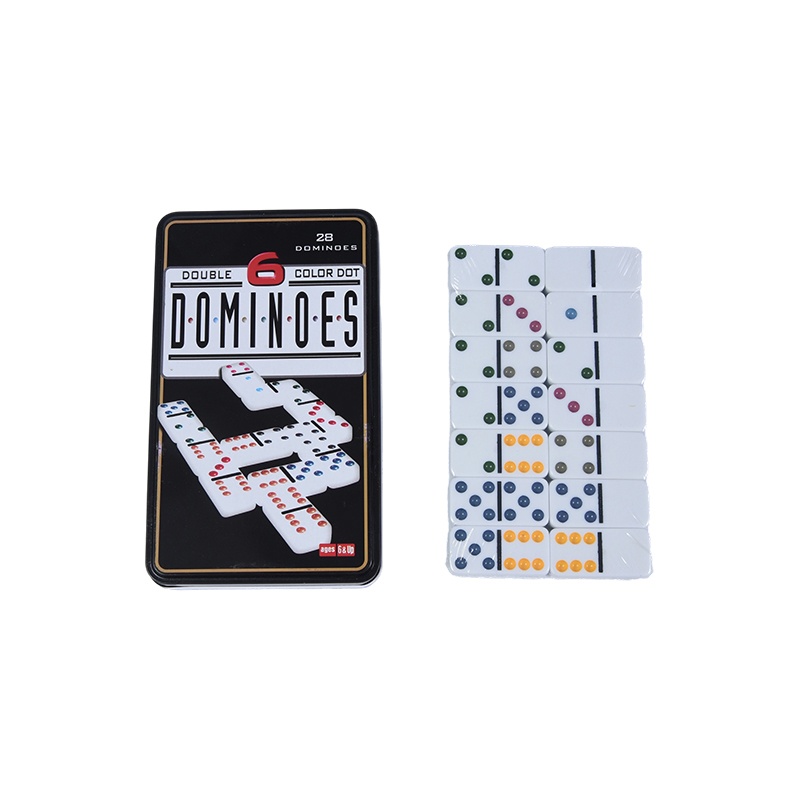 Double-Six Colorful Dot Dominoes Iron Box SetEvent-grade 28-tile melamine domino set with dot markings and a tinplate storage box for competitive, family, or gift use.View Product →
This is the ground we work on daily at Ningbo Royal Import And Export Co., Ltd. We are a professional game product sets manufacturer and game gift products factory, equipped with complete testing facilities and strong technical force. Our products are diverse in variety, superior in quality, reasonable in price and fashionable in design, and are widely used in industries such as gaming. They have been widely recognized and trusted by users and can meet the constantly changing economic and social demands. We welcome new and old customers from all walks of life to contact us for future business relations and common success. For a longer look at how tile and board classics are produced, our notes on classical board games cover much of the same ground.
Q1: What colors are mahjong tiles?
Chinese-style sets use blue and green circles for Dots, green with red accents for Bamboo, and red with dark blue for Characters. Dragons are red 中, green 發 and a blue or black 白. These are conventions rather than rules.
Q2: Do the colors on an American mahjong card tell me which suit to play?
No. On the NMJL card, ink color shows how many suits a hand uses. It does not map onto tile colors, so red does not always mean Craks.
Q3: How many tiles are in a standard set?
144 in the common four-player version: 36 Dots, 36 Bamboo, 36 Characters, 16 Winds, 12 Dragons and 8 bonus tiles.
Q4: What is the red five tile in Japanese mahjong?
Akadora, a red 5 in each suit that counts as a bonus tile under many modern rules. It is a deliberate color addition, not a printing error.
Q5: Can colorblind players play mahjong?
Yes. Tile identity comes from characters and counts, so red-green weakness rarely blocks play. High-contrast printing and matte finishes make sets easier for everyone.
Q6: Can mahjong tiles be made in custom colors?
Usually yes on printed plastic and wood tiles. Custom ink normally means a minimum order quantity and a slightly longer lead time than standard colorways.
One last visual, because it explains most color complaints in a single glance: the color lives on the printed face, while the body, thickness and back are separate decisions made at the same time. Change one and the set reads differently, even if the other two stay the same.

A professional enterprise specializing in the production of game gift products, with complete testing equipment and strong technical force.
Read MoreCONTACT US
For exclusive deals and latest offers, sign up by entering your email address below.
ORGANAIZATION INFO
Address: No. 329, Fangyan Road, Luotuo Street, Zhenhai District, Ningbo City, Zhejiang Province, China.
Phone:+86 15990507778
E-mail:[email protected]
Copyright © Ningbo Royal Import And Export Co., Ltd. All Rights Reserved. China Game Product Sets Manufacturers Wholesale Game Gift Products Factory privacy



 English
 Español
 Deutsch