
 2026.09.23
 Industry News
Your custom tarot deck has cleared the biggest creative hurdle: all 78 illustrations are finished, the borders are consistent, the back design matches your brand, and the guidebook is typeset. The decision that now separates a professional product from a disappointing stack of printed cards is the specification you send to the factory. The short version: start with a precise spec sheet, choose the right cardstock and finish, and work with a manufacturer that tests game products before you commit to a bulk order.
This guide covers the specification choices, printing technology, quality-control checkpoints, cost drivers, and supplier criteria that matter when you produce a custom tarot deck through a board game manufacturer.
Content
Factories quote from numbers, not from renderings. If your enquiry says only "custom tarot deck with my artwork," you will receive vague pricing that changes after sampling. Define the format before you ask for a quote.
The classic tarot deck contains 78 cards: 22 Major Arcana and 56 Minor Arcana. Oracle decks are more flexible, usually 44-60 cards, but retail buyers expect the full 78-card structure from a tarot deck. Size matters because it drives printing cost, cardstock usage, packaging dimensions, and shipping weight.
| Format | Card count | Dimensions | Best use case |
|---|---|---|---|
| Standard tarot | 78 | 70 x 120 mm | Reading decks, retail, collectors |
| Mini tarot | 78 | 44 x 80 mm | Travel and pocket use |
| Poker size | 78 | 63.5 x 88.9 mm | Hybrid card games, lighter shipping |
| Oracle deck | 44-60 | 70 x 120 mm | Daily-draw and affirmation decks |
Most custom tarot projects settle on the standard 70 x 120 mm format. It is the size readers expect, and factories print it on the same equipment used for premium game cards, which keeps tooling costs predictable.
Cardstock weight defines the hand feel and is the specification that buyers notice first. In board game manufacturing, 300 gsm is the standard reference for a durable card: it holds its shape through years of shuffling and does not take a permanent bend when stored in a jacket pocket. 330-350 gsm is chosen when rigidity matters more than easy shuffling, while 280 gsm is an economy option that works if the deck is handled gently.
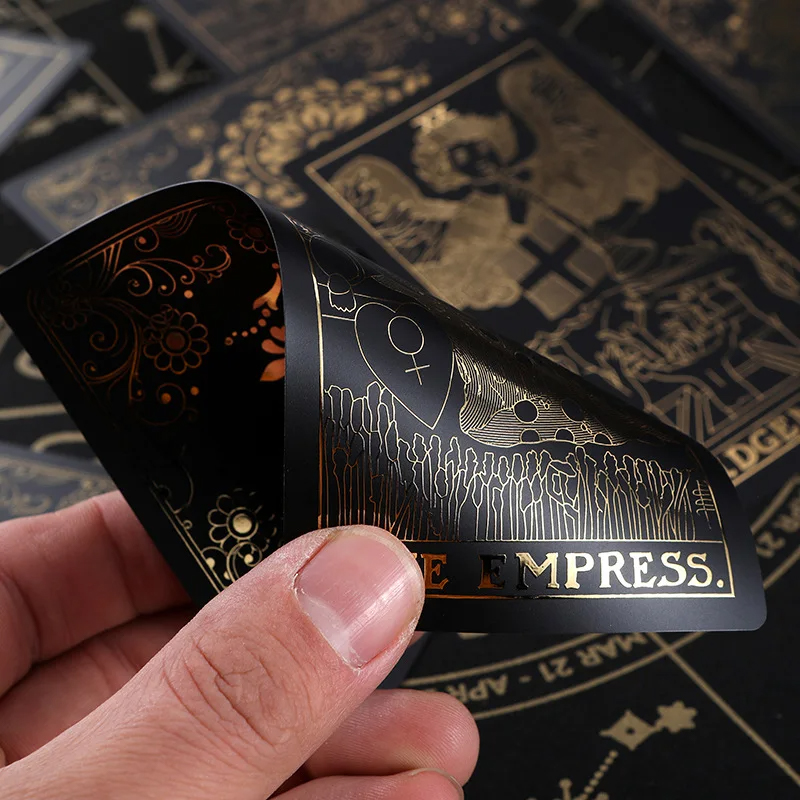 Black PVC Classic Tarot Cards with 24K Gold ElectroplatingThis premium 78-card deck features a matte PVC-coated finish with 24K gold electroplated motifs and a 350gsm cardstock, offering an elegant option for collectors and buyers comparing cardsto...View Product →
The layer structure of a printed tarot card explains why cardstock and finish must be specified together.
Layer structure of a custom tarot card: finish, ink, core, back ink, and back finish.
If you want a premium edge, gilding is the standard route. Gold or silver foil is pressed onto the stacked card edges with a heated die after cutting. Gilded decks cost more, but they photograph well and support a higher retail price.
Two printing technologies dominate custom tarot deck production. Offset printing is the right choice for runs above 500 decks: it delivers the sharpest detail, accurate spot-color reproduction, and the lowest per-unit cost at volume. Digital printing makes sense for 50-200 deck pilot runs, crowdfunding prototypes, or test editions, but the cost per deck is higher and batch-to-batch color matching is harder.
Color accuracy depends on the proofing method. A digital proof shows layout and approximate tone; only a physical sample pressed on the production cardstock seals the deal, because ink absorption differs between 280 gsm and 350 gsm board and between matte and linen surfaces.
Prepare your artwork files this way:
If your deck includes gold foil details, the foil is a separate print process that must be planned at the file-preparation stage; it adds roughly one extra production step and a few days of lead time.
Quality problems rarely appear in a digital preview. They show up in the first shuffle: corners that chip, borders that are not square, colors that shift between proof and production, and lamination that peels along the edge. A reliable factory builds checkpoints into the process instead of inspecting only the finished deck.
| Checkpoint | Acceptance criterion |
|---|---|
| Card dimension | 70 x 120 mm, tolerance within 0.5 mm |
| Color accuracy | Delta E within 3 against approved proof under daylight |
| Corner cutting | Consistent radius, no chipping |
| Edge gilding | Even foil coverage, no exposed white core |
| Print registration | Borders aligned within 0.3 mm |
Ask the factory which measurements it records during production and whether it can supply inspection reports. A manufacturer with in-house testing facilities can verify dimensions, color values, and packaging integrity before the deck ships, which prevents expensive overseas returns.
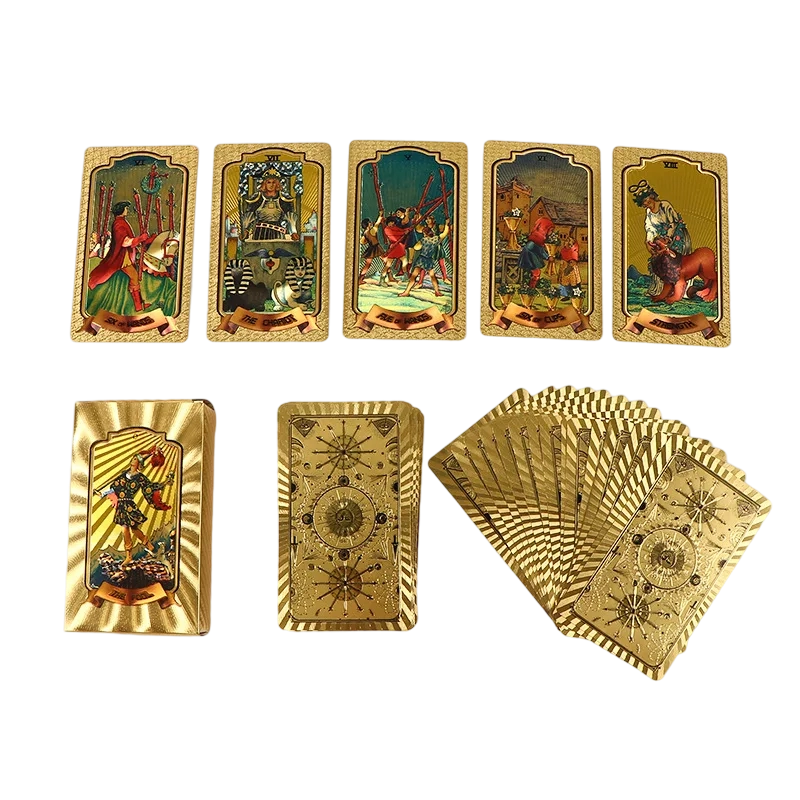 Premium Gold-Foil Tarot Cards Set with Raised IllustrationsA luxurious 78-card Rider-Waite deck with non-tarnish gold foil, textured raised details, and a rigid cardstock, ideal for those exploring high-end finishes and gift-ready packaging.View Product →
The price of a custom tarot deck is controlled by card count, size, cardstock weight, finish, gilding, box design, and the guidebook. The biggest lever is order quantity, because offset plates, make-ready, and die-cutting tools are fixed costs spread across the run. The chart below shows an indicative wholesale range for a standard 78-card deck at 300 gsm as quoted by Chinese board game factories.
Indicative per-deck price for a 78-card custom tarot deck at 300 gsm by order quantity.
On timing, a typical production schedule for a custom tarot deck is: one week for design proofing, one to two weeks for sampling, two to four weeks for bulk printing and finishing, and one week for inspection and packing. If you ship by sea from Ningbo to a US West Coast port, allow another 15-22 days of transit.
Typical lead time per stage for a custom tarot deck order, excluding freight delays.
A custom tarot deck is a branded product, so judge the supplier on three things: game-specific manufacturing experience, in-house testing, and export documentation practice. A factory that already produces board games and playing cards understands registration tolerances, cardstock sourcing, and the packaging standards that international buyers expect.
Ningbo Royal Import And Export Co., Ltd., based in Ningbo, China, is a professional game product set manufacturer and game gift products factory. The company operates with complete testing facilities and strong technical force, and its catalog spans educational games, classic games, tabletop games, and accessories, with a tarot range covering black PVC reading decks, gold-foil collector editions, and themed crystal editions. The company combines reasonable pricing with fashionable design and quality control, and it can test products against GB, EN, and REACH requirements — an advantage when your export market asks for compliance documentation. Wholesale and custom branding enquiries are handled directly with the factory.
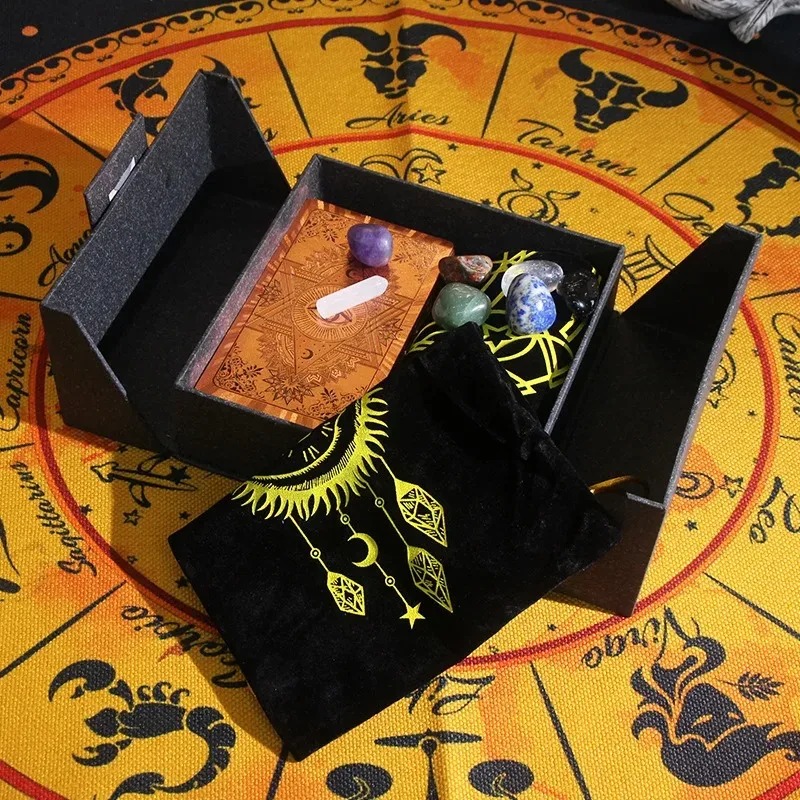 Zodiac-Themed Holographic Tarot & Crystal Set in Gift BoxThis collectible edition pairs iridescent tarot cards with tumbled crystals and a velvet pouch, all in a magnetic gift box, appealing to buyers seeking a themed, all-in-one mystical package.View Product →
When the first physical sample arrives, test it the way your end customer will. Shuffle it two hundred times, fan the cards, photograph them under studio light, and check the corners with a loupe. If a supplier's deck passes that routine, its quality system is working. For help with reading and presenting the finished deck, see our beginner's guide to reading tarot cards. Then compare quotes on the same specification sheet — card count, size, cardstock, finish, gilding, packaging, and lead time — so the comparison is honest.
Most board game factories require 500-1,000 decks for offset printing. Some accept 100-200 decks with digital printing, but the per-unit cost is higher.
Yes. Provide print-ready files at 300 DPI in CMYK with at least 3 mm bleed. The factory will create a digital proof and a physical sample for approval.
300 gsm with a matte or linen finish is the most common choice for reading decks. Choose PVC plastic if you need waterproof and crease-proof cards.
A typical order takes 3-6 weeks including sampling and production, plus 15-22 days of sea freight to North American ports.

A professional enterprise specializing in the production of game gift products, with complete testing equipment and strong technical force.
Read MoreCONTACT US
For exclusive deals and latest offers, sign up by entering your email address below.
ORGANAIZATION INFO
Address: No. 329, Fangyan Road, Luotuo Street, Zhenhai District, Ningbo City, Zhejiang Province, China.
Phone:+86 15990507778
E-mail:[email protected]
Copyright © Ningbo Royal Import And Export Co., Ltd. All Rights Reserved. China Game Product Sets Manufacturers Wholesale Game Gift Products Factory privacy



 English
 Español
 Deutsch