
 2026.11.09
 Industry News
Picture a 1.2 m coffee table, two children aged seven and eleven, and a budget of about €60. That is the real decision context behind most mini foosball and mini air hockey purchases, and it explains why the two formats get compared so often: both fit on a shelf, both are ready to play in under a minute, and both answer the question of what to do after dinner. They reward completely different skills, though, and the model that fits your room is not always the one your family enjoys most.
The comparison below is built around the details buyers actually trip over: playing area, side clearance, moving parts, noise, and how each game survives daily use by children.
Content
Mini air hockey is the better buy for mixed-age groups, quick drop-in games, and rooms where the table cannot be reached from both long sides. Mini foosball is the better buy for two players of similar ability who want a skill they can improve at, and for anyone who likes the mechanical feel of a proper table game.
Foosball is a linkage game. You turn a rod, the figures on that rod rotate with it, and the ball only moves when a figure strikes it. Passing, blocking and angled shots all come from timing that rotation and reading where the ball will land. Mini tables usually cut the eleven-a-side arrangement down to four or six rods, but the linkage logic is unchanged, which is exactly why foosball feels like something you can practise.
 Wooden Mini Football Tabletop FoosballCompact solid-wood foosball table with chrome rods, 11 figures and manual scoring, suited to practising timing and angled shots at home.View Product →
Air hockey is a free-body game. There is no linkage at all: the puck sits on the surface, you drive it with a mallet, and the game becomes geometry plus reaction speed. Set-up is a puck and two mallets, and the rules fit into one sentence. Players who have never handled a small table can pick up the essentials quickly from this beginner’s guide to playing mini air hockey, which covers stance, grip and the bank shot.
The difference becomes obvious over time. Foosball has a steep, visible skill ladder, so a beginner loses to a regular almost every game — motivating for some players, demoralising for others. Air hockey flattens out faster, because reflexes and a little luck close more of the gap, and a seven-year-old can beat an adult now and then. Most of the strong opinions you will read online trace back to that single difference.
Tabletop versions in this class typically run somewhere between 40 cm and 60 cm across the playing field, and that range hides a practical difference. A 60 cm rod-style foosball table needs clear space at both ends so the rods can slide and hands can grip them — usually 10 to 15 cm per side. Push it into a bookshelf alcove and half the rods become unusable.
Air hockey needs no side clearance at all, but it does need a genuinely flat base: a warped top or a soft carpet makes the puck drift and turns every rally into an argument. Measure the table, then measure the gap to the nearest wall. Under 20 cm on both long sides, and foosball will frustrate everyone who plays it.
Before looking at price, look at the parts that decide whether the game survives a year of family use. The diagram below marks the components that matter most on a rod-style table.
On a mini foosball table, four details separate a durable unit from a disposable one:
Air hockey has far fewer parts, so the whole judgement rests on the surface and the puck. Most tabletop air hockey tables under roughly 60 cm skip the blower and rely on a smooth, low-friction playing surface, which means that surface quality is the entire game. A glossy top that scuffs will slow the puck unevenly. Check puck weight and rim too — a light puck with a hard rim skates well, while a heavy puck on a rough surface feels like pushing a coin — and look at goal depth, because shallow goals bounce the puck straight back out and players read that as a rules problem rather than a build problem.
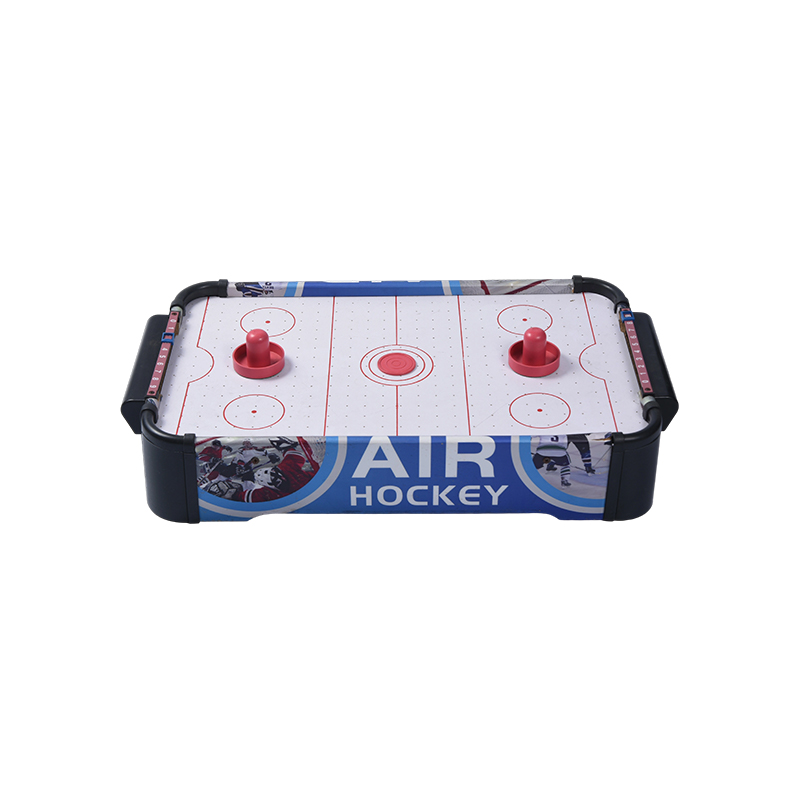
 Mini Air Hockey Tabletop SetCompact battery-powered air-hockey table with fan cushion, two mallets and two pucks, sized for small-space play and quick arcade-style matches.View Product →
Scorecards are subjective, so treat the chart below as a framework rather than a verdict and reweight it for whoever will actually play.
Read it this way: air hockey is easier to start and easier to share, foosball is harder to start and more rewarding to master. Durability and quietness sit in the middle and depend far more on build quality than on the format itself.
Three common situations settle the question faster than any specification sheet. Where neither format clearly wins — a family room used by everyone, all week — a combined table is often the cheaper answer than buying twice.
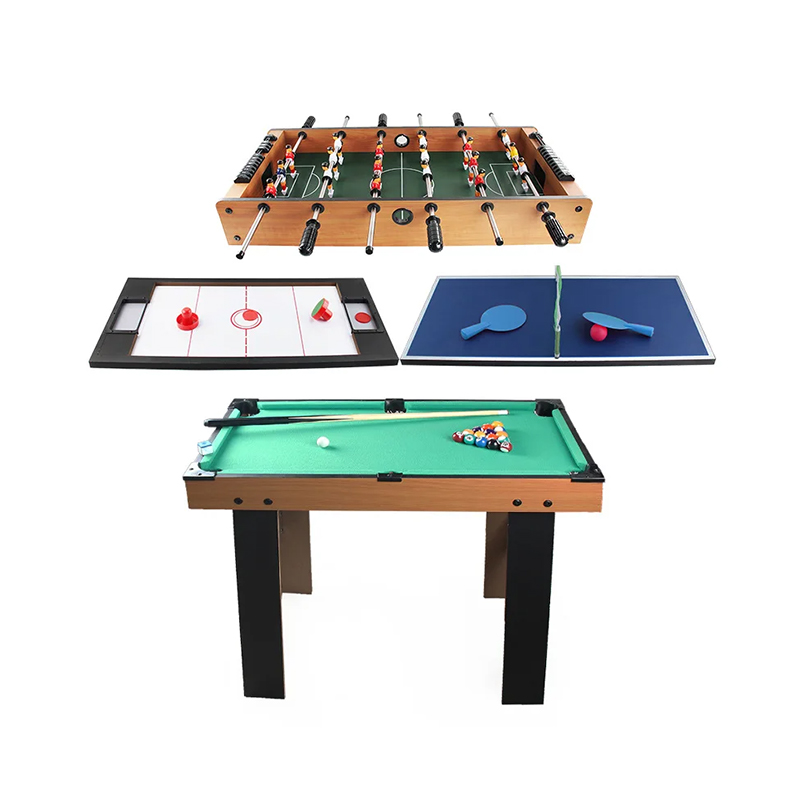
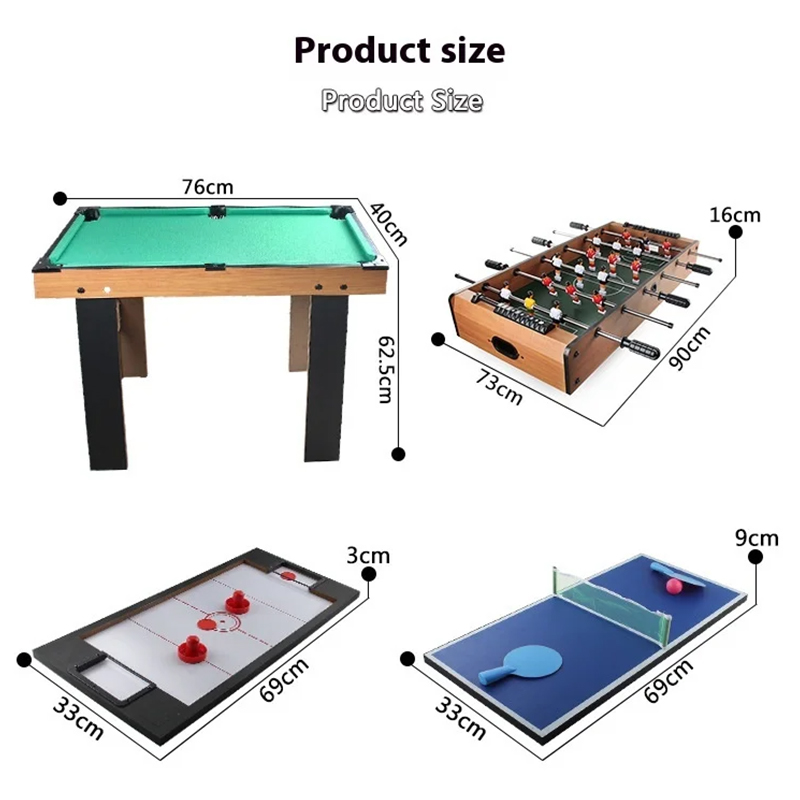 4-in-1 Foosball, Air Hockey, Table Tennis and Pool TableWooden-frame multi-game table with quick-release conversion among foosball, air hockey, table tennis and pool, plus built-in storage for family game rooms.View Product →
Air hockey takes this one, mainly because it can be played from one long side and needs no rod clearance. Both formats are noisy, so plan for a mat underneath: the sharp puck impacts of air hockey and the rhythmic clacking of foosball figures carry through a floor more than most buyers expect.
Air hockey works from about five or six, once a child can hold a mallet and track a fast object. Foosball usually clicks around eight, when rotation timing and hand-eye coordination catch up. Check small parts either way — pucks, mallets and player figures are all choking-hazard sized for toddlers.
Foosball is the classic break-room choice because it hosts two-a-side play and encourages conversation between turns. Air hockey suits shorter, sharper breaks but generates more noise near desks. If you are fitting out a shared space, it helps to compare scale and packaging across a broader tabletop game range before committing to one format.
Two boxes matter: the assembled size and the packed size. A 60 cm foosball table that arrives flat-packed still needs the assembled footprint plus rod clearance in the room, and a mini air hockey table needs a level, non-carpeted surface. Confirm that mallets, pucks, balls and score sliders are included, and ask about spare player figures and rods if the table will be used by children.
Ningbo Royal Import And Export Co., Ltd. is a professional game product sets manufacturer and game gift products factory, equipped with complete testing facilities and strong technical force. Our products are diverse in variety, superior in quality, reasonable in price and fashionable in design, and are widely used in industries such as gaming. Our products have been widely recognized and trusted by users and can meet the constantly changing economic and social demands. We welcome new and old customers from all walks of life to contact us for future business relations and common success.

A professional enterprise specializing in the production of game gift products, with complete testing equipment and strong technical force.
Read MoreCONTACT US
For exclusive deals and latest offers, sign up by entering your email address below.
ORGANAIZATION INFO
Address: No. 329, Fangyan Road, Luotuo Street, Zhenhai District, Ningbo City, Zhejiang Province, China.
Phone:+86 15990507778
E-mail:[email protected]
Copyright © Ningbo Royal Import And Export Co., Ltd. All Rights Reserved. China Game Product Sets Manufacturers Wholesale Game Gift Products Factory privacy



 English
 Español
 Deutsch