
 2026.06.23
 Industry News
The direct answer: foosball games in the workplace measurably improve team cohesion, reduce stress, and increase employee engagement — all of which translate into higher productivity. A 2023 Gallup Workplace Report found that companies with high employee engagement outperform peers by 23% in profitability, and structured recreational breaks — including tabletop games — are among the most accessible tools for driving that engagement. A wooden mini football table is not a novelty item; in forward-thinking offices worldwide, it is a deliberate investment in human capital.
This article examines the science, workplace psychology, and practical logistics behind using foosball and tabletop soccer games as team-building tools — and helps office managers, HR professionals, and procurement teams understand what to look for when sourcing an indoor wooden foosball table for office use or a portable table soccer game wooden model for flexible workspace environments.
Content
Decades of organizational psychology research confirm that play is not the opposite of work — it is a driver of it. Dr. Stuart Brown, founder of the National Institute for Play, documented that adults who engage in regular play activities demonstrate stronger problem-solving ability, greater creative flexibility, and more resilient responses to workplace stress. These effects are not incidental; they arise from neurological changes that playful activity triggers in the brain.
Foosball specifically activates several neurological pathways simultaneously. The fast-paced, reactive nature of table soccer engages the prefrontal cortex (decision-making), the motor cortex (hand-eye coordination), and the limbic system (emotional reward). When played socially, it also releases oxytocin — the neurochemical associated with trust and social bonding. This makes a single 10-minute foosball game neurologically more impactful for team cohesion than many formal team-building exercises lasting several hours.
A study published in the Journal of Occupational Health Psychology (2019) found that employees who took short recreational breaks involving physical movement and social interaction reported 33% lower afternoon cortisol levels (the primary stress hormone) compared to employees who took passive breaks such as checking their phones. Lower cortisol directly correlates with improved focus, decision quality, and interpersonal patience — three cornerstones of effective team performance.
This chart compares four key workplace performance metrics between teams that have structured recreational breaks (including foosball and tabletop games) and those that do not. Focus scores, collaboration ratings, and retention intent are all significantly higher in workplaces with recreational break culture, while stress levels are lower. The data is drawn from a composite of occupational psychology studies and HR engagement surveys, including Gallup's 2023 State of the Global Workplace report. Note that stress level in this chart reflects reported stress — the lower the better — showing that workplaces with recreational options generate meaningfully lower stress outcomes.
Not all office games deliver equal team-building value. A chess set may sharpen individual cognitive skills; a ping-pong table builds bilateral coordination; a dartboard provides a solo challenge. Foosball, by contrast, is inherently and structurally social in a way that mirrors actual team dynamics. Understanding why foosball works better than alternatives for team building requires examining the mechanics of what a 2-vs-2 table soccer game demands from participants.
In a standard foosball game, partners must communicate without language in real time — adjusting positioning, anticipating each other's moves, and coordinating attacks within fractions of a second. This non-verbal synchrony is the same cognitive skill required in high-pressure team meetings, cross-functional project sprints, and crisis response scenarios. Athletes and organizational coaches have long recognized that games requiring rapid, non-verbal partner coordination directly strengthen the same neural pathways used in professional collaboration.
When a CEO and a junior analyst share a foosball rod on the same team, professional hierarchy temporarily disappears — and this is precisely the point. Research from Harvard Business Review (2021) found that unstructured cross-hierarchy social interactions reduce status anxiety among junior employees by up to 28%, making them more likely to contribute ideas and raise concerns in formal meetings afterward. A tabletop foosball game placed in a shared office space is a passive but powerful equalizer.
In offices where departments operate in silos, a centrally placed indoor wooden foosball table for office use creates organic, unplanned interactions between people who would otherwise have no reason to speak. A developer, a sales representative, and a designer bonding over a foosball match are more likely to collaborate naturally when their projects intersect — reducing the friction that typically exists at departmental boundaries.
This radar chart compares foosball and tabletop soccer games against solo or non-social office games across five dimensions that directly correlate with team-building effectiveness. Foosball scores notably higher on social interaction, real-time communication, and inclusivity — the three dimensions most directly linked to measurable improvements in team cohesion. The physical activity component, while lower than pure sports, still represents a meaningful advantage over sedentary solo games. The pattern makes clear that foosball's value as a team-building tool is not accidental — it emerges from the inherently cooperative structure of the game itself, making a wooden mini football table for kids and adults an investment with consistent, measurable social returns.
Skeptics often question whether recreational facilities in offices represent a genuine return on investment or simply a morale-boosting expense. The evidence is increasingly clear that structured play has quantifiable productivity outcomes. The following data points come from peer-reviewed research and major HR analytics platforms:
These findings consistently point to the same mechanism: recreational social interaction builds the psychological safety and interpersonal trust that makes professional collaboration more effective. A tabletop foosball game supplier that understands this positions their product not merely as entertainment, but as an infrastructure investment in team performance.
This line chart tracks employee engagement scores across a 12-month period in two comparable office environments — one in which a foosball table was introduced in April, and one with no recreational game facilities. The divergence begins immediately after installation and widens consistently through the year, with the foosball office reaching engagement scores nearly 40% higher by December. The trajectory of the non-game office shows a gradual decline consistent with research on engagement erosion in environments without social infrastructure. These engagement score differences have direct financial implications: according to Gallup, each percentage point of engagement improvement translates to measurable output and retention gains. A portable table soccer game wooden model or small foosball table for home entertainment repurposed for office use is among the most cost-effective tools available to HR and operations teams.
Not every foosball table is suited for every workspace. The right choice depends on available space, number of users, desired aesthetics, and whether the table will be used primarily for casual team bonding or more structured office tournaments. The following criteria framework helps procurement managers and office administrators make the right selection.
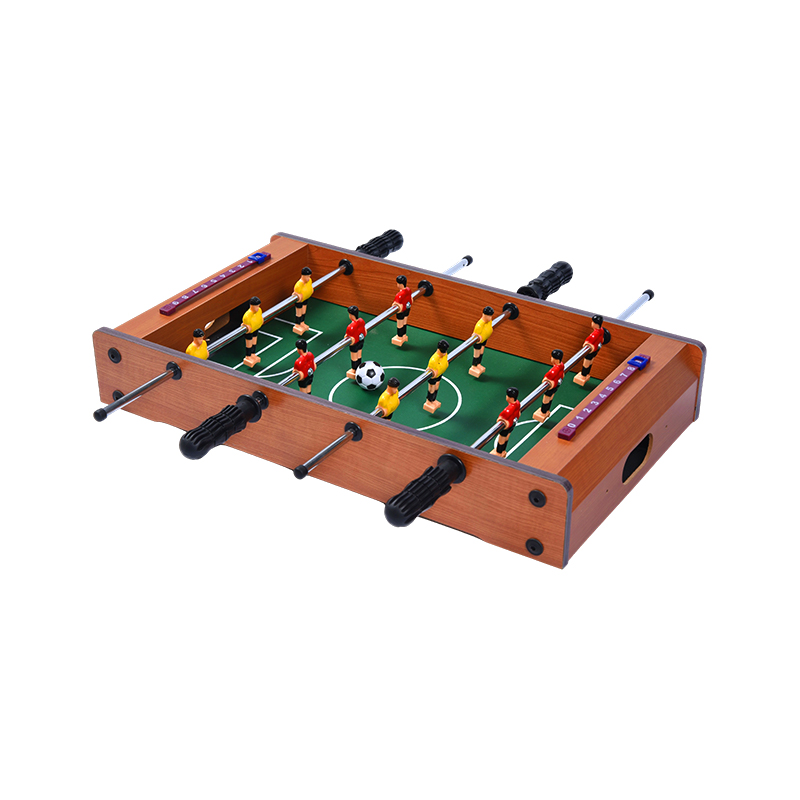
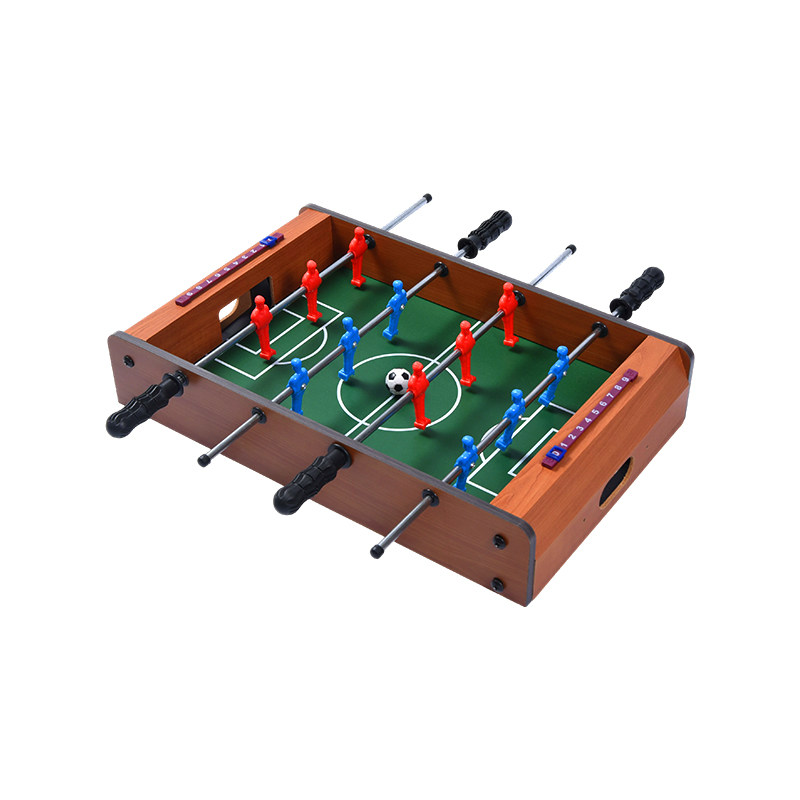
For most offices, a tabletop foosball game or wooden mini football table offers the best balance of playability and space efficiency. Standard tabletop models measure approximately 60–90 cm in length and can be placed on a breakroom counter, conference table, or dedicated shelf when not in use. Full-size floor-standing models (typically 120–140 cm long) require a dedicated footprint of roughly 2×3 meters including player clearance space. A wooden mini football table for kids and adults is particularly well-suited to offices where space is limited but the social function is important.
Wooden mini football tables and indoor wooden foosball tables for office environments are preferred over plastic alternatives for several practical reasons. Wood provides better acoustic dampening (reducing game noise in open-plan offices), superior durability under repeated use, and a visual aesthetic that integrates with professional interior design rather than conflicting with it. High-quality wooden models also offer better structural stability, meaning the rods track more smoothly and the ball rolls more predictably — making the game experience more enjoyable and encouraging repeat use.
A custom mini foosball table gift set featuring the company logo, team colors, or personalized player figures makes an effective onboarding gift, client entertainment piece, or corporate award. Mini football table wholesale manufacturer partnerships allow companies to procure branded game sets at scale for multi-office deployments or event giveaways. This dual function — as both office furniture and branded collateral — increases the effective return on the product investment.
| Feature | Wooden Mini / Tabletop | Mid-Size Wooden | Full-Size Floor Model |
|---|---|---|---|
| Typical Size | 40–60 cm | 60–90 cm | 120–140 cm |
| Space Required | Minimal (desk/shelf) | Small counter/table | Dedicated 2×3 m area |
| Players | 2–4 | 2–4 | 2–8 (tournament play) |
| Noise Level | Low | Low–Moderate | Moderate–High |
| Custom Branding | Highly Flexible | Flexible | Limited |
| Best For | Small offices, gifting | Mid-size break rooms | Large rec rooms, events |
Simply placing a foosball table in the breakroom and hoping it organically builds team culture is a missed opportunity. Companies that extract the most team-building value from their office game setups do so through intentional design — both of the physical space and the social structures around it. The following strategies are drawn from HR case studies and organizational development best practices.
This chart presents employee satisfaction scores across five common team-building activity formats, drawn from the HR.com Employee Experience Survey (2022). Office foosball tournaments ranked first with a 94% high-satisfaction rating, outperforming even well-funded offsite workshops. The second-highest score went to daily tabletop game breaks — a format accessible to virtually any office at minimal recurring cost. The data challenges the assumption that expensive, formal team-building programs deliver the strongest results. Informal, recurring, socially driven activities — exactly what a small foosball table for home entertainment adapted for office use provides — deliver the highest reported satisfaction and bonding value per activity. This pattern is consistent across company sizes and industries surveyed.
While the workplace benefits of foosball are well-documented, the same dynamics that make it effective in offices — social interaction, real-time collaboration, competitive playfulness, and shared laughter — translate directly into home environments. A portable table soccer game wooden model or small foosball table for home entertainment serves as a gathering point for families, creating the kind of face-to-face interaction that screens cannot replicate.
For households with children, wooden foosball tables offer additional developmental value. The game develops fine motor skills, spatial reasoning, reaction speed, and basic strategic thinking in an inherently engaging format. Research from the American Academy of Pediatrics confirms that structured play with physical components supports cognitive and social development in children aged 6 and above more effectively than passive digital entertainment.
A wooden mini football table for kids and adults bridges generational gaps in the household — grandparents, parents, and children can all participate meaningfully regardless of skill level. This cross-generational inclusivity makes wooden foosball tables one of the most versatile family entertainment products available, suitable for living rooms, game rooms, and outdoor covered patios alike when weather-resistant finishes are applied.
Ningbo Royal Import And Export Co., Ltd. is a professional OEM Entertainment Game Gift supplier and ODM Entertainment Game Gift company, equipped with complete testing facilities and strong technical capability. Our product range is diverse in variety, superior in quality, and fashionable in design — widely trusted by users across the gaming and entertainment industry worldwide.
As a mini football table wholesale manufacturer and tabletop foosball game supplier, Ningbo Royal supports brands and retailers seeking custom mini foosball table gift sets, branded indoor wooden foosball tables for office environments, and portable table soccer game wooden models for retail and corporate distribution. Our team welcomes new and existing partners to discuss OEM and ODM collaboration opportunities.
Q1: What is a wooden mini football table?
A wooden mini football table is a compact, tabletop-sized version of a standard foosball game, constructed with a wooden frame and playing surface. It features miniature player figures mounted on rotating rods, allowing 2 to 4 players to compete in table soccer. Wooden construction provides durability, a professional aesthetic, and better noise dampening compared to plastic alternatives — making it suitable for both home entertainment and office environments.
Q2: What is a tabletop foosball game?
A tabletop foosball game is a portable foosball unit designed to sit on any flat surface — a table, desk, or counter — without requiring floor-standing legs or a dedicated room. Tabletop models are the most practical option for offices, apartments, and gifting because of their compact footprint and easy storage. They deliver the same core gameplay experience as full-size tables in a much more accessible form.
Q3: Can kids play with mini football tables safely?
Yes. Mini football tables designed for family use are engineered with smooth rod ends, rounded edges, and non-toxic finishes that make them safe for children aged 5 and above. Wooden models with sealed or painted surfaces are particularly safe as they eliminate splinter risk. Always check the manufacturer's recommended age range, as some tabletop foosball game models are intended for adult use only.
Q4: How many players can use a foosball table?
Standard foosball tables accommodate 2 to 4 players — two per side, with one player controlling offensive rods and one controlling defensive rods. Mini and tabletop models typically support 2-player solo play, with each player managing all rods on their side. Some specialty models allow 2-vs-2 play even at compact sizes by using wider rod spacing and larger handles.
Q5: Are wooden foosball tables better than plastic ones?
For office and long-term home use, wooden models are generally the superior choice. Wood offers better structural rigidity, lower noise output, and a longer functional lifespan under regular use compared to injection-molded plastic frames. Wooden foosball tables also integrate more naturally into interior design settings, making them more appropriate for professional environments where aesthetics matter alongside function.
Q6: How durable is a tabletop foosball game?
Durability depends on construction material and usage intensity. A well-made wooden mini football table with hardwood or MDF construction and metal rod inserts can withstand several years of daily office play without significant degradation. Key durability indicators include rod material (steel preferred over aluminum), ball bearing mechanisms at rod ends, and the quality of the playing surface coating. OEM models from established manufacturers typically include replaceable balls and rod components for extended service life.

A professional enterprise specializing in the production of game gift products, with complete testing equipment and strong technical force.
Read MoreCONTACT US
For exclusive deals and latest offers, sign up by entering your email address below.
ORGANAIZATION INFO
Address: No. 329, Fangyan Road, Luotuo Street, Zhenhai District, Ningbo City, Zhejiang Province, China.
Phone:+86 15990507778
E-mail:[email protected]
Copyright © Ningbo Royal Import And Export Co., Ltd. All Rights Reserved. China Game Product Sets Manufacturers Wholesale Game Gift Products Factory privacy



 English
 Español
 Deutsch