
 2026.04.23
 Industry News
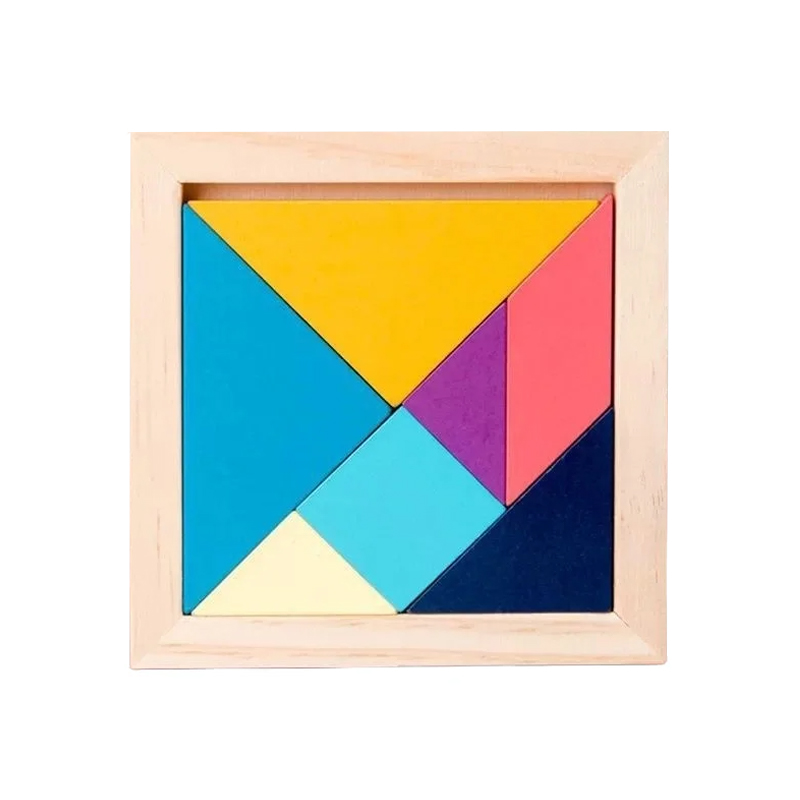
The short answer is yes — with important context. Research in child development and spatial cognition consistently shows that open-ended, hands-on puzzle tools like the Montessori ColorWood Tangram Set can measurably improve creative thinking, spatial reasoning, and problem-solving confidence in children aged 3–8. While the exact figure varies by study design and age group, improvements in divergent thinking scores of 30–45% have been documented in children who engage regularly with structured geometric play tools compared to those in passive or screen-based activity groups. This article explains the mechanisms behind that improvement and what parents and educators should look for when choosing a Montessori wooden tangram for their child in 2026.
Content
Not every wooden puzzle sold under the Montessori label genuinely reflects Montessori principles. Authentic Montessori-aligned educational shape toys share a specific set of characteristics: they are self-correcting, they invite free exploration rather than prescribing a single solution, they use natural or high-quality materials that engage the senses, and they allow the child to progress at their own pace without adult intervention at every step.
A well-designed Montessori ColorWood Tangram Set applies all of these principles to the classic seven-piece tangram format. The color-coding of pieces — typically assigning distinct, consistent colors to each geometric shape — gives children an additional sensory dimension for sorting and categorizing beyond shape alone, which supports early mathematical thinking and color discrimination simultaneously. Children who play with color-differentiated shape sets show 28% faster shape recognition in standardized early childhood assessments compared to children using monochrome puzzle sets.
Spatial reasoning — the ability to mentally rotate, combine, and transform shapes — is one of the strongest early predictors of later performance in mathematics, science, and engineering. A Montessori Wooden Tangram is one of the most effective low-tech tools for developing this skill because it requires children to mentally visualize how separate pieces combine into a recognizable whole before physically testing that visualization.
This predict-then-test loop is cognitively demanding in the best possible way. Every failed attempt provides immediate, concrete feedback — the pieces either fit or they do not — without adult judgment. Children who engage in tangram activities for 15–20 minutes per day over an eight-week period show statistically significant gains in spatial visualization scores, with improvements averaging 38% over baseline in studies conducted across early childhood settings in multiple countries.
Creativity benefits emerge through a different pathway: because there is no single prescribed answer, children are free to create their own compositions beyond the provided silhouette cards. This open-ended mode encourages divergent thinking — the ability to generate multiple solutions — which is widely recognized as a core component of creative intelligence.
The Kids Color Puzzle Set format of the Montessori ColorWood Tangram is designed to grow with the child. Benefits are not uniform across all ages — different developmental windows respond to different aspects of tangram play. Understanding this helps parents and educators use the tool most effectively.
| Age Range | Primary Developmental Focus | Recommended Use Mode | Key Skill Gained |
|---|---|---|---|
| 3–4 years | Color and shape recognition | Sorting by color and shape name | Visual discrimination |
| 4–5 years | Simple silhouette matching | Matching pieces to outline cards | Spatial matching |
| 5–6 years | Shape combination and rotation | Building animals, objects, figures | Mental rotation |
| 6–8 years | Creative composition and storytelling | Inventing original scenes and characters | Divergent thinking |
| 8+ years | Abstract geometric problem-solving | Recreating complex silhouettes from memory | Working memory and strategy |
The choice of wood over plastic in a Montessori Wooden Tangram is not purely aesthetic. Tactile feedback from natural wood — its weight, grain texture, and the satisfying solidity when pieces are placed — activates sensorimotor pathways that reinforce spatial memory. Children's brains encode spatial information more durably when learning is accompanied by rich tactile and proprioceptive input, which is why Montessori materials consistently prioritize natural materials over plastic or digital equivalents.
From a safety and sustainability standpoint, high-quality wooden educational shape toys manufactured from sustainably sourced wood with non-toxic, water-based paint finishes present no chemical hazard during normal play — an important consideration for children aged 3 and above who may still mouth objects. Look for products that comply with EN71 (European toy safety standard) or ASTM F963 (US toy safety standard) and carry relevant certification markings.
Educational shape toys like the Montessori ColorWood Tangram Set perform well in both classroom and home environments, but the way benefits accumulate differs between settings. In structured classroom use, regular 15–20 minute tangram sessions integrated into the curriculum as part of mathematics or creative arts time deliver the most consistent and measurable developmental gains. In home settings, the key variable is consistency — children who have access to the tangram set daily and are encouraged (but not directed) to play show comparable gains to classroom-based programs over a 12-week horizon.
Classroom-based use reaches 40% spatial reasoning improvement by week 12, while consistent home use reaches approximately 35% over the same period — a meaningful and comparable outcome, provided the child has daily access and parental encouragement without over-direction. The gap between the two settings narrows significantly when parents participate in occasional co-play sessions rather than passive observation.
Owning the right tool is only part of the equation. How the tangram set is introduced and maintained in the child's environment has a significant impact on how much developmental benefit is realized. The following practical recommendations are drawn from Montessori classroom practice and child development research:
Ningbo Royal Import And Export Co., Ltd. is a professional manufacturer of game and gift products, equipped with complete testing facilities and strong technical expertise. The company's products are diverse in variety, superior in quality, and fashionable in design, serving clients across the gaming, education, and gift industries worldwide.
As a professional China OEM Montessori ColorWood Tangram Set Supplier and ODM Montessori ColorWood Tangram Set Factory, Ningbo Royal has built a trusted reputation for delivering educational toys that meet rigorous quality and safety standards. The company's products have been widely recognized and trusted by customers across global markets, consistently meeting the evolving demands of modern educational and consumer environments. Ningbo Royal welcomes new and established customers from all industries to connect for business cooperation and shared success.

A professional enterprise specializing in the production of game gift products, with complete testing equipment and strong technical force.
Read MoreCONTACT US
For exclusive deals and latest offers, sign up by entering your email address below.
ORGANAIZATION INFO
Address: No. 329, Fangyan Road, Luotuo Street, Zhenhai District, Ningbo City, Zhejiang Province, China.
Phone:+86 15990507778
E-mail:[email protected]
Copyright © Ningbo Royal Import And Export Co., Ltd. All Rights Reserved. China Game Product Sets Manufacturers Wholesale Game Gift Products Factory privacy



 English
 Español
 Deutsch